
To become a Nevada notary, you must be 18 or older, a Nevada resident with civil rights (or a qualifying worker from an adjoining state), finish the Secretary of State's course and exam, file a $10,000 bond and your oath with the county clerk, and apply with a $35 fee. Appointments run four years and cover the whole state. Renewal repeats the course. Below are the steps, costs, stamp rules, journal duties and renewal.
Engineer Seal Stamps compliance desk. Checked against NRS 240.010, 240.015, 240.018, 240.020, 240.030, 240.036 and 240.120, NAC Chapter 240, and the notary bond pages of the Clark County, Washoe County, Carson City and Douglas County clerks. Sources read September 2026.
| Requirement | Nevada answer | Source |
|---|---|---|
| Who can apply | Nevada resident, 18 or older, with civil rights; an adjoining-state resident may qualify through a registered Nevada business or regular Nevada employment | NRS 240.015 |
| Disqualifications | Conviction of, or a guilty or no contest plea to, a crime of moral turpitude or a misappropriation crime such as fraud, forgery or embezzlement | NRS 240.010 |
| Course and exam | Secretary of State course of at least 3 hours that ends in an exam; the completion certificate is valid 90 days | NRS 240.018; NAC 240.270 |
| How to apply | File the bond and oath with the county clerk, then send the application, the clerk's filing notice and course proof to the Secretary of State | NRS 240.030; Carson City and Washoe County clerk pages |
| Application fee | $35 to the Secretary of State | NRS 240.030(1)(a) |
| Bond | $10,000 surety bond to the State of Nevada, filed with the county clerk; clerks list a $20 filing fee | NRS 240.030(1)(d); county clerk bond pages |
| Oath and filing | Constitutional oath filed with the bond; the certificate of appointment issues after those filings are certified | NRS 240.030(1)(b), (4) |
| Commission term | Four years, valid in any part of Nevada | NRS 240.020 |
| Stamp or seal | Rectangular stamp no larger than 1 by 2.5 inches with fixed wording and your certificate number. See the Nevada notary stamp guide | NRS 240.040 |
| Journal | Required for each act, entered when the act is performed; kept 7 years after you stop being a notary | NRS 240.120 |
| Renewal | Course again, plus the fee, oath and bond that NRS 240.030 sets for each applicant | NRS 240.018(3)(b); NRS 240.030 |
| Electronic notary | Separate registration after an electronic notarization course finished within 90 days before registering | NAC 240.648; NAC 240.650 |
Two national tables put this Nevada guide in context: which states require a notary journal and where remote online notarization is allowed.
Who can become a notary public in Nevada?
Nevada appoints residents who are at least 18, hold their civil rights and have completed the state's mandatory course. A resident of a neighboring state can also qualify through a Nevada workplace that meets the conditions in NRS 240.015.
For an adjoining-state resident, that means either a place of business in Nevada registered under chapter 76 of NRS and local business rules, or regular employment at a Nevada office, business or facility whose employer is registered to do business in the state. Douglas County's clerk notes that nonresidents also complete the Nonresident Notary Public Affidavit forms with their employer.
Some histories block an appointment. Under NRS 240.010, the Secretary of State will not appoint anyone convicted of, or who pleaded guilty or no contest to, a crime involving moral turpitude or a misappropriation offense such as burglary, embezzlement, forgery, fraud, identity theft or robbery. You also declare under penalty of perjury that no state has revoked or suspended a notary appointment of yours, and the Secretary of State may ask for fingerprints.
What are the steps to a Nevada notary appointment?
Nevada puts the bond first. You finish the course, then file your bond and oath with the county clerk, and only then send the application and fee to the Secretary of State, who issues the certificate of appointment.
- Complete the course and exam. The Secretary of State offers at least one course a month, and the completion certificate is good for 90 days.
- Buy a $10,000 surety bond payable to the State of Nevada. Douglas County asks that it show your name as it reads on your photo ID, plus your physical address.
- Sign the bond and the oath. Clark County's clerk asks that the oath be signed by you and a notary public.
- File with the county clerk where you live, bringing the original bond and photo ID and paying the $20 filing fee. The clerk gives you a filing notice.
- Apply to the Secretary of State with the filing notice, proof of the course, the revocation declaration and the $35 fee.
- Receive the certificate of appointment. It issues once the application, fee and certified bond and oath filings are in.
- Order your stamp and journal using the certificate number and end date shown on your certificate.
Clerks accept only the original bond, not a copy, and a bond or oath missing a signature can be turned away at the counter.
What does the Nevada notary course cover?
The mandatory course runs at least three hours and ends with an exam. It is required for first-time applicants, for every renewal, and for notaries the Secretary of State sends back to class after a violation or suspension.
The Secretary of State provides the course and may charge a reasonable enrollment fee; the statute names no figure, so confirm the current amount when you enroll. Your certificate of successful completion is valid for 90 days under NAC 240.270, so file the bond and application inside that window.
What are the costs of a Nevada notary appointment?
The fixed government charges are $35 to the Secretary of State and a $20 filing fee at the county clerk. The course fee, the bond premium and your supplies depend on who provides them.
- Application: $35, paid when you submit.
- County clerk filing: $20 in Clark County, Washoe County, Carson City and Douglas County.
- Course: a reasonable fee set by the Secretary of State.
- Bond premium: priced by the surety for the $10,000 bond.
- Name change: $10, filed within 30 days.
- Stamp and journal: bought after the certificate arrives.
How does the $10,000 Nevada notary bond work?
Every applicant enters into a $10,000 bond to the State of Nevada and files it with the clerk of the county of residence. The bond's effective date matters, because a Nevada appointment starts on that date.
The county clerk certifies the filing to the Secretary of State, and the clerk's filing notice travels with your application. Clerks want the original, signed bond, and Douglas County wants it written for that county.
Which stamp should a newly appointed Nevada notary order?
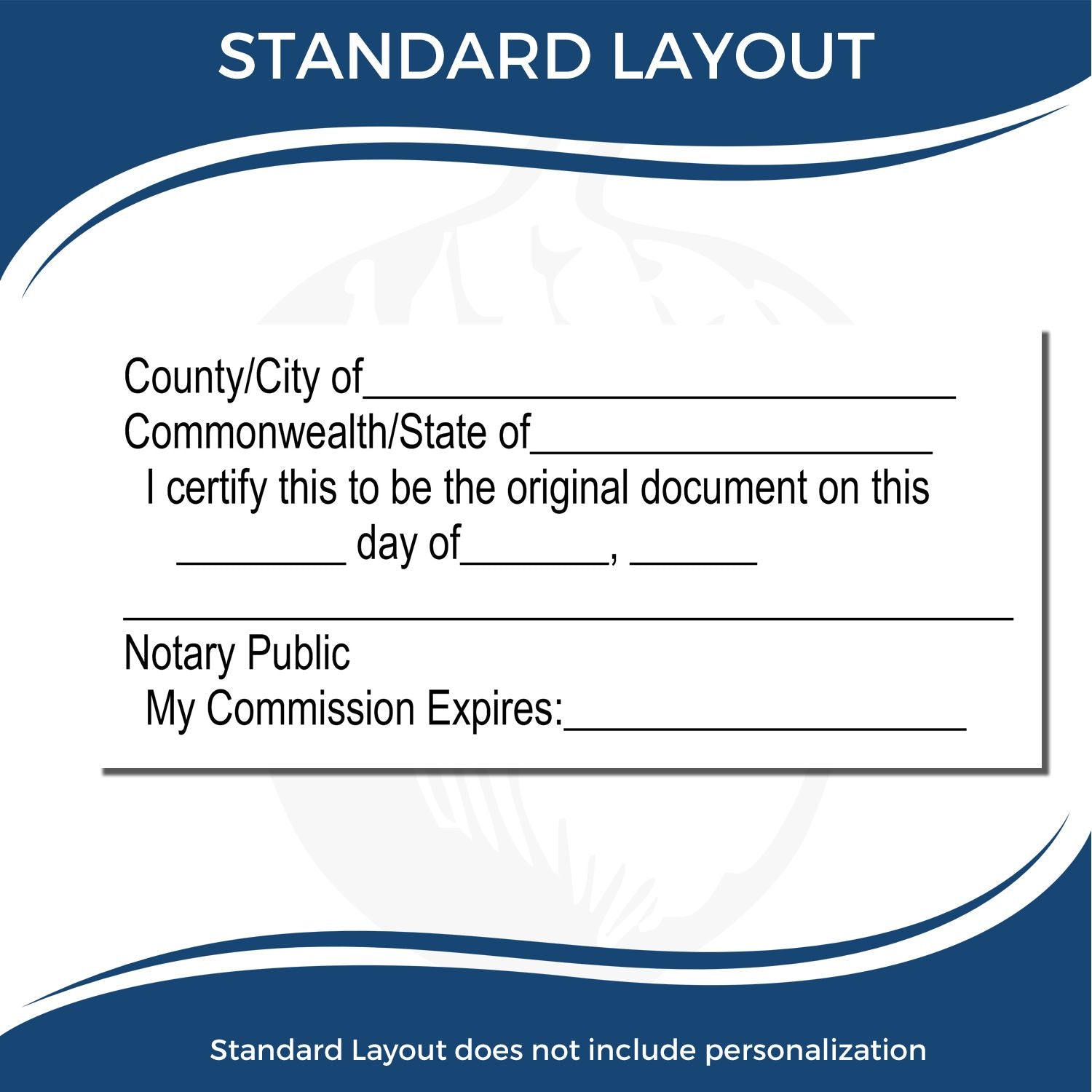
A rectangular rubber or other mechanical stamp no larger than 1 by 2.5 inches, showing your name, Notary Public, State of Nevada, the date your appointment ends and the number from your certificate of appointment, in indelible, photographically reproducible ink.
The certificate number and end date exist only once the Secretary of State issues the certificate, so the stamp is ordered after that point. An embosser may be added but never replaces the stamp. See the Nevada notary stamp size and wording guide for the details of each line.
Nevada gives you 10 days to report a lost or stolen stamp, a far shorter deadline than the 30 days allowed for most record changes.




What does Nevada require in a notary journal?
Each Nevada notary keeps a journal in the office and makes an entry for each notarial act at the moment it is performed. The journal must be kept until seven years after you stop being a notary public.
- The fees charged, if any
- The title of the document
- The date you performed the act
- The name and signature of the person whose signature is notarized
- A description of the evidence used to identify that person
- Whether you administered an oath
- The type of certificate used
One entry may cover several acts when they are performed for the same person at the same time, on one document or on similar documents.


How do you renew a Nevada notary appointment?
Renewal works much like the first appointment. You retake the mandatory course, and NRS 240.030 applies the same $35 fee, oath and $10,000 bond to each person applying for appointment, so a new term starts when its new bond takes effect.
Your stamp shows the date the appointment ends, so the old stamp cannot carry into the new term. Order one with the new date once the new certificate arrives, and see the ESS guide to checking the expiration date on a notary seal if you are unsure which date yours shows.
For how early a renewal may be filed, confirm with the Secretary of State's notary division before you book the course, and time the class so its 90-day certificate is still valid when you apply.
Which changes must a Nevada notary report within 30 days?
Report a new name to the Secretary of State within 30 days with a $10 fee. The same 30 days applies to a new mailing address, county of residence or signature, and for adjoining-state notaries, a new Nevada place of business or employment.
Under NRS 240.036, those other changes are made by requesting an amended certificate of appointment on the Secretary of State's form. A name change also leaves your stamp out of date, so order a replacement showing the new name once it is on record.
Can Nevada notaries notarize electronically?
Yes, through a separate registration as an electronic notary public. A commissioned notary completes the course of study on electronic notarization, no earlier than 90 days before registering, and pays the fee the Secretary of State charges.
The electronic seal generally follows the size and other requirements NRS 240.040 sets for a mechanical stamp (NAC 240.705). An electronic journal must not allow anyone to delete a record or change its content or sequence (NAC 240.708).
Frequently asked questions
Do I file the Nevada bond before or after I apply?
Before. The county clerk records the bond and oath and hands you a filing notice, and you submit that notice, the application and the $35 fee to the Secretary of State.
Can a Nevada notary work anywhere in the state?
Yes. NRS 240.020 lets a notary perform notarial acts in any part of Nevada for the four-year term.
Can I be a Nevada notary if I live in California, Arizona, Utah, Idaho or Oregon?
Yes, if you meet NRS 240.015: a registered place of business in Nevada, or regular work at a Nevada office, business or facility for an employer registered in the state.
How long is the Nevada course certificate valid?
Ninety days from issue, under NAC 240.270. If it lapses before your application is complete, take the course again.
Is an embosser enough in Nevada?
No. An embosser can be used in addition, but it cannot stand in for the inked rectangular stamp.
When your certificate of appointment arrives, pick a Nevada rectangular stamp or a starter kit from the ESS Nevada stamps and seals collection. To see how other states handle stamp shape and wording, read our notary seal requirements for every state.