

To become a Georgia notary, you must be 18, a U.S. citizen or legal resident living in the county where you apply, complete the required training, and file an application with two endorsers at the county clerk of superior court, where you pay the fee and take the oath. Residents of a bordering state who work in Georgia apply in the county where they work. Georgia requires no bond. Fees run $40 to $55 by county, and commissions last four years.
Engineer Seal Stamps compliance desk. Checked against the Georgia Superior Court Clerks' Cooperative Authority's notary pages and O.C.G.A. Title 45, Chapter 17. Sources read September 2026.
| Item | Georgia rule | Source |
|---|---|---|
| Basic qualifications | At least 18, a U.S. citizen or legal resident, a legal resident of the county you apply from, with a working phone number and the ability to read and write English. | O.C.G.A. § 45-17-2(a) |
| Out-of-state applicants | A resident of a bordering state who works or does business in Georgia applies in that Georgia county. | O.C.G.A. § 45-17-7 |
| Training | An educational training class before your first appointment and before each renewal, approved by the GSCCCA. | O.C.G.A. § 45-17-8(h); GSCCCA Notary Public Educational Rules |
| Exam | No state exam appears in the qualifications or the training rules. | O.C.G.A. § 45-17-2; GSCCCA Notary Public Educational Rules |
| Where to apply | The clerk of superior court in your county, using the GSCCCA online application where the county takes part. | O.C.G.A. § 45-17-2.1; GSCCCA Notary Public Application |
| Endorsements | Two endorsers for a first appointment: not relatives, 18 or older, living in your county, and acquainted with you for at least a month. | O.C.G.A. § 45-17-2.1 |
| Fee | $40 to $55, depending on the county, for a new appointment or a reappointment. | GSCCCA General Notary Information |
| Bond | None. | GSCCCA General Notary Information |
| Oath | Taken before the clerk of superior court before you act. | O.C.G.A. § 45-17-3 |
| Commission term | Four years. | O.C.G.A. § 45-17-5(a) |
| Seal | Your name as commissioned, Notary Public, Georgia or GA, and the commissioning county; stamp or embosser. See our Georgia notary seal rules. | O.C.G.A. § 45-17-6(a)(1) |
| Journal | Required since January 1, 2025 for each act performed for a self-filer. | O.C.G.A. § 45-17-8(g) |
| Renewal | File no more than 30 days before expiration, with a new training certificate and the same county fee. | GSCCCA General Notary Information; O.C.G.A. § 45-17-4 |
Record keeping and remote acts differ widely by state. The Georgia rules sit beside every other jurisdiction in notary journal requirements by state and remote online notarization and the electronic seal.
Who can become a notary in Georgia?
Georgia applicants must be 18 or older, hold U.S. citizenship or legal residency, live as a legal resident of the Georgia county they apply from, read and write English, and have an operating telephone number. Georgia commissions its notaries county by county.
The county residency rule has one exception. Someone who lives in a state bordering Georgia and carries on a business or profession here, or is regularly employed here, applies to the clerk in the county where that work happens (O.C.G.A. § 45-17-7). Once commissioned, a nonresident holds the same powers as a resident notary.
The application also asks you to disclose any past denial, revocation or suspension of a notary commission, and any criminal conviction other than a minor traffic violation (O.C.G.A. § 45-17-2.1). The clerk of superior court decides whether to grant the commission.
How do you apply for a Georgia notary commission, step by step?
You apply through the clerk of superior court in your county, not a state agency. Finish the training first, because the certificate of completion goes in with your application, then complete the form, collect endorsements and take everything to the clerk's office.
- Complete the training. The GSCCCA offers an approved course through its eLearning site, and you receive a certificate of completion when you finish.
- Check how your county takes applications. The GSCCCA lists the counties that use its web-based application; if yours is not listed, ask the clerk's office for its process.
- Fill out the application. Select your county, choose new or renewal, submit, and print the completed form.
- Sign the declaration before a notary. The applicant declaration must be signed in the presence of a commissioned Georgia notary.
- Collect two endorsements. A first-time application needs two unrelated adults from your county who have known you for at least one month.
- Visit the clerk of superior court. Bring the signed application, the training certificate and proof of county residence the statute accepts, such as a Georgia driver's license, and pay the fee.
- Take the oath. The clerk administers it and records it in the clerk's minutes.
- Receive your certificate of appointment. The clerk issues the certificate plus a duplicate original, which you will need to order your seal.
The GSCCCA's Notary Public Application page walks through the online form and links the county list.
What does a Georgia notary commission cost?
The clerk's fee for a new appointment or a reappointment is $40 to $55, and the exact amount depends on the county. Georgia has no bond premium and no exam fee, so the other costs are the training course and the seal.
The fee is set under O.C.G.A. § 15-6-77 and paid to the clerk, who keeps the part covering the certificate, the oath and recording and forwards $2 to the GSCCCA for the statewide notary record (O.C.G.A. § 45-17-4). A reappointment costs the same as a first appointment.
What training does Georgia require, and is there an exam?
Since January 1, 2025, Georgia requires an educational training class on notary duties before your first appointment and again within 30 days before each renewal. The GSCCCA approves the course, and no separate state exam appears in the law or the training rules.
The requirement came from House Bill 1292 of 2024, which amended O.C.G.A. § 45-17-8. The GSCCCA's Notary Public Educational Rules call for successful completion of the course, and the certificate of completion accompanies your application to the clerk.
Renewing notaries need a fresh certificate each term. The rules define a renewal appointment as one granted within 30 days before the current commission expires, so time the course to fall inside that window.
Does Georgia require a notary bond?
No. The GSCCCA's General Notary Information page states that Georgia notaries need no bond, and the qualifications in O.C.G.A. § 45-17-2 do not list one. Your start-up costs are the county fee, the training and the seal.
The same holds at renewal: you repeat the training, the application and the fee, with no bond to buy or record.
Which seal should you order, and when can it be made?
Order the seal after the clerk issues your commission. Georgia law makes presenting the duplicate original certificate to the seal supplier, by mail or in person, the step that authorizes the supplier to make and deliver your seal (O.C.G.A. § 45-17-5(b)).
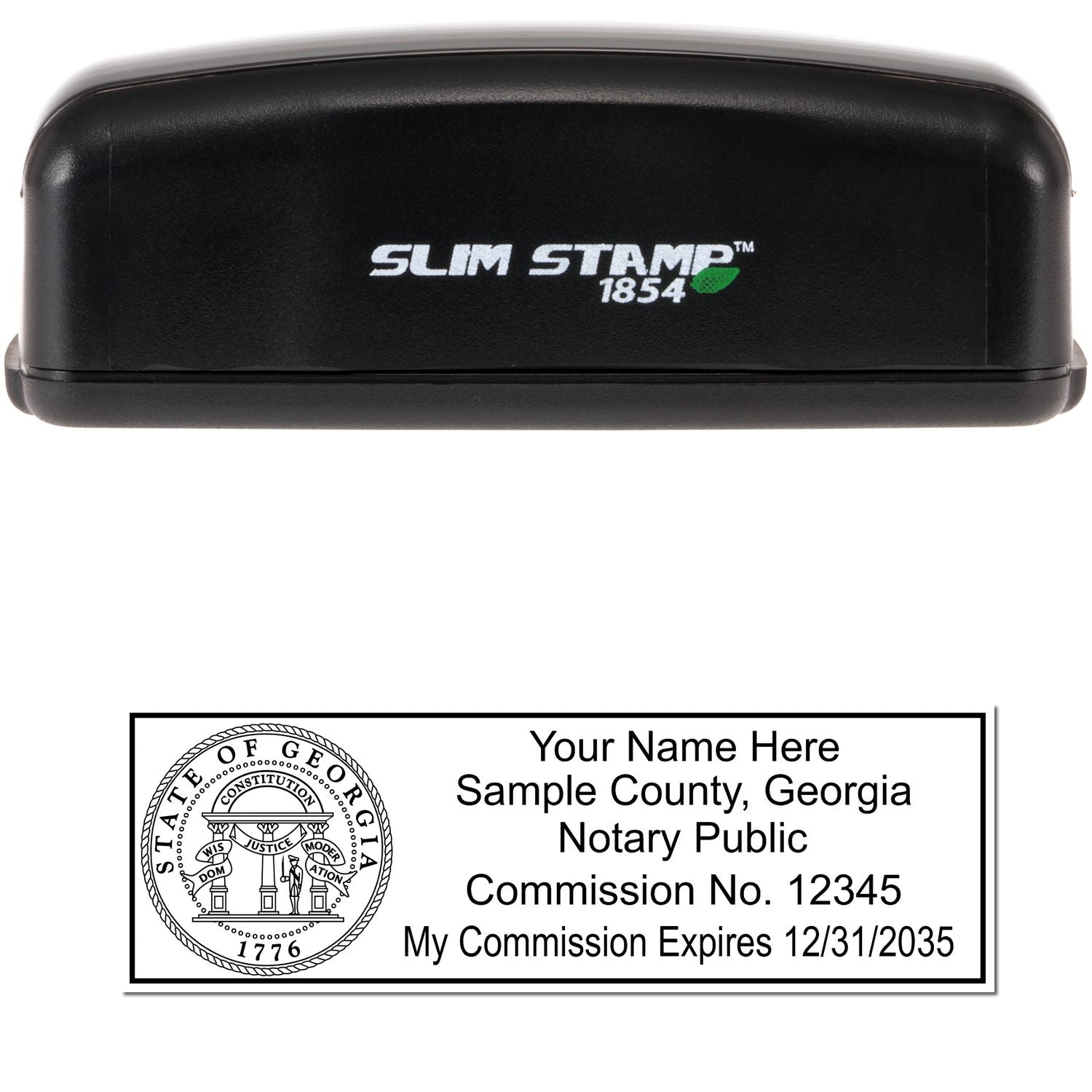
The seal shows your name exactly as it appears on the commission, Notary Public, Georgia or GA, and the county that commissioned you (O.C.G.A. § 45-17-6(a)(1)). An inked stamp alone is sufficient, an embosser is allowed, and no size, shape or ink color is set. Our Georgia notary seal rules page covers each line.
A handwritten scrawl does not count as a seal, so the stamp or embosser needs to be in hand before your first notarization.







When does a Georgia notary have to keep a journal?
Since January 1, 2025, a Georgia notary must keep a written or electronic journal entry for every notarial act performed for a self-filer. The journal rule in O.C.G.A. § 45-17-8(g) is limited to those acts.
A self-filer is a party to a deed, mortgage, lien or other recordable instrument who is not one of the professionals the recording statute excludes, such as attorneys, title insurance agents, bank representatives and mortgage lenders (O.C.G.A. § 44-2-2).
Each entry records the self-filer's name, address and telephone number; the date, time and place; the type of photo ID and its details, unless you know the signer personally; the self-filer's signature; and the type of document. The statute gives no retention period. The GSCCCA summarizes the rule on its Georgia Notary Law page.








How long does a Georgia commission last, and how do you renew?
A Georgia commission runs four years. You may typically submit a renewal no more than 30 days before your term ends, with a new training certificate, and the clerk renews it by order for another four-year term.
Renewal uses the same application and fee as a first appointment, while the endorsement requirement in O.C.G.A. § 45-17-2.1 is written for initial appointments. Your existing seal can stay in service if every detail on it still matches your commission.
If you let the commission lapse without applying, or your renewal is denied, the law requires you to destroy the seal (O.C.G.A. § 45-17-18). Check the date on your certificate with our guide to notary commission expiration dates.
What do you do after a name, address or phone change?
Send written notice to your appointing clerk of superior court, with a copy to the GSCCCA, so that it reaches the clerk within 30 days of the change. The GSCCCA provides a contact information change form for this purpose.
A name change notice lists the old and new names, your new signature and any new address. You may not notarize under the new name until the clerk confirms the change and you have a new seal showing the new name exactly (O.C.G.A. § 45-17-13).








Frequently asked questions
Can a Georgia notary work outside the county that commissioned them?
Yes. O.C.G.A. § 45-17-9 lets notarial acts be performed in any county in the state. The county on your seal records where you were commissioned, not a limit on where you may act.
How much can a Georgia notary charge?
The GSCCCA's summary of Georgia notary law gives $2 as the authorized fee for each notarial act.
Is there a Georgia notary certification?
The certificate you earn is the certificate of completion from the required training, which you hand in with your application. The commission itself comes from the clerk of superior court as a certificate of appointment.
My Georgia notary seal is missing. Who do I tell?
Put it in writing within 10 days: notify the clerk of superior court that commissioned you, and send the GSCCCA a copy.
Where can I read Georgia notary law and get the forms?
The GSCCCA publishes a summary of the law, the educational rules and the notary forms, including the contact change form, on its Georgia Notary Law page. The law itself is O.C.G.A. Title 45, Chapter 17, Article 1.
Once the clerk hands you the certificate and its duplicate original, order a stamp or embosser from our Georgia notary stamps and seals. See the Georgia notary seal rules for every line the seal must show, and our notary seal requirements by state for how Georgia compares.