
Why Electrical PEs Face Unique Seal Compliance Challenges
Picture this: an electrical PE seals a set of plans in a discipline-specific license state without realizing their stamp legally restricts them to electrical work only. The permit gets rejected. A board complaint is filed. The project stalls. This scenario plays out more often than most engineers expect, and the financial impact is significant. Permit rejections due to non-compliant PE seal submissions cost project teams $2,000 to $5,000 per project, before accounting for crew rescheduling and client delays.
Most PE seal guidance available online is written with civil or structural engineers in mind. Electrical PEs are underserved by existing compliance content, despite growing demand for electrical engineers projected at roughly 7% between 2023 and 2033 according to BLS occupational outlook data.
Every electrical PE must navigate two compliance layers: state licensing board rules and local AHJ (Authority Having Jurisdiction) requirements. This article covers the key variables you need to understand: discipline-specific vs. general license states, physical vs. digital seal rules, and the three-part certification requirement that applies in all 50 states plus DC.
The Three-Part Certification Requirement Every PE Must Meet
Regardless of your state or discipline, a complete PE certification requires three elements: the seal image, a handwritten or electronic signature, and a date. All three must appear on the document for formal certification to be valid. Missing any one of these elements means the document is not properly certified, and filing offices will reject it.
For electrical engineers, this matters especially on multi-page drawing sets. Depending on your state, the seal, signature, and date must appear on each individual sheet or on a designated cover sheet. There is no universal standard; electrical PEs should verify their state board's specific position on multi-sheet sealing before submitting permit packages.
A common and costly mistake involves circulating draft PDFs that visually resemble sealed documents. If a draft includes a seal image but lacks a proper signature or date, it can be mistaken for a certified final. This is a board violation. Circulating unsealed drafts that look like finals creates liability and can trigger disciplinary review.
When revisions are necessary, re-sealed documents must clearly mark what has changed, and prior sealed versions should not remain in circulation. ASCE has identified improper use of the PE seal, including sealing documents not prepared under the engineer's direct supervision, as one of the most common violations adjudicated by state licensing boards. Electrical PEs must treat the three-part certification as non-negotiable on every document they certify.
Discipline-Specific License States vs. General License States
This is the distinction that catches the most electrical PEs off guard. In discipline-specific license states, your PE seal is legally restricted to your licensed discipline. An electrical PE cannot stamp mechanical or structural plans, and a mechanical PE cannot stamp electrical plans, even if they are personally qualified to do the work. The license designation on the seal controls what work can be certified.
States that issue discipline-specific PE licenses relevant to electrical engineers include Alaska, Arizona, California, DC, Guam, Hawaii, Louisiana, Massachusetts, Nebraska, Nevada, and Vermont, among others. In these jurisdictions, the discipline designation must appear on the seal itself. California, for example, requires the discipline on the stamp and mandates a minimum 1.5-inch, maximum 2-inch diameter.
Contrast this with general-license states like Texas, where the PE license is not discipline-specific. However, engineers in Texas are still bound by competency requirements. Sealing electrical plans outside one's training and qualifications can trigger enforcement actions. Texas also requires each licensed engineer to submit a seal impression or electronic seal, plus signature, to the Board upon license issuance.
The practical implication for electrical PEs working across state lines is significant. A general-license state stamp will not satisfy a discipline-specific state's filing requirements. If you hold a Texas PE and need to seal electrical plans in California, you must obtain a California electrical PE license with the proper discipline designation on your seal. There is no workaround.
State-by-State Seal Format Rules Electrical Engineers Must Know
California: The discipline must appear on the stamp. For electrical PEs, the seal must explicitly read "Electrical Engineer." The stamp diameter must be between 1.5 and 2 inches. No exceptions.
New York: Embossing, rubber stamp, or electronic seal formats are all accepted. Every sealed document must also carry a warning stamp stating it is a violation of law to alter the document without direction from a licensed PE. This warning requirement applies regardless of seal format.
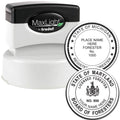
Maryland: The seal must feature the Great Seal of Maryland at its center, surrounded by "State of Maryland" and "Professional Engineer," plus the licensee's name and license number. The required diameter is between 1-5/8 and 2 inches.
New Jersey: Paper documents still require an embosser-type seal. Electrical PEs working on paper permit sets in New Jersey must maintain a physical embosser in addition to any digital seal they use for electronic submissions.
Oregon: Reduced or enlarged seals are prohibited on final documents. For electronic final documents, a digital signature must be independently verifiable by a Certificate Authority and linked to the document so that any alteration invalidates it. This is one of the more rigorous digital sealing standards in the country.
Hawaii: Digital or electronic seals and signatures are not permitted. This makes Hawaii one of the most restrictive states for electrical PEs using PDF-based workflows. All certifications must use traditional methods.
Florida: Electronically sealed documents must include a notice stating the document has been electronically signed and sealed and that printed copies are not considered signed and sealed.
Beyond state board rules, local AHJs (building departments, utility interconnection offices) may impose additional requirements. Engineers must verify compliance at both the state and local filing-office level before submitting sealed documents.
Digital PE Seals: Compliance Standards and Common Pitfalls
Digital seals are becoming increasingly standard as e-permitting portals, remote work, and cloud collaboration expand across the engineering profession. Compliance standards vary widely by jurisdiction, however, and assumptions about what constitutes a valid digital seal can lead to rejected submissions.
Image-only seals, such as scanned stamps or JPEG/PNG seal images without cryptographic verification, and password-free PDFs typically do not comply with state board digital sealing regulations. A seal image pasted into a PDF is not the same as a properly executed digital seal.
Oregon's standard (Certificate Authority verification with a document-linked signature that invalidates on alteration) represents the more rigorous end of the compliance spectrum. Florida's notice requirement for electronically sealed documents is a formatting detail that electrical PEs using e-permitting portals frequently overlook, resulting in avoidable rejections.
The hybrid workflow problem is real. Some states still require embossers or wet stamps for certain document types even when digital seals are generally accepted. Electrical engineers working on multi-format projects (paper permit sets plus PDF submittals) must maintain both physical and digital sealing capabilities.
At EngineerSealStamps.com, we include a free digital seal with many professional seal purchases, giving electrical engineers a convenient electronic version built for PDF and digital plan submission workflows. Engineers should always verify current digital seal rules with their state licensing board before sealing final documents, as requirements continue to evolve and staying current is the engineer's responsibility.
Enforcement Trends and the Cost of Getting It Wrong
State boards in Texas, Pennsylvania, West Virginia, and other jurisdictions are actively publishing disciplinary cases where improper seal use is a leading violation category. This is not a theoretical risk; it is a documented enforcement trend.
In West Virginia, civil penalties for PE seal misuse typically range from $250 to $1,000 per combination of violations, such as unlicensed practice plus seal misuse. Pennsylvania's State Board issued disciplinary actions in 13 reviewed cases between 2023 and 2025, with administrative lapses and reporting failures among the most common issues.
The financial impact extends well beyond fines. Permit rejections due to incorrect or non-compliant PE seal submissions cost project teams $2,000 to $5,000 per project before crew rescheduling and client delays compound the losses.
The October 2025 launch of updated NCEES PE Electrical and Computer exam specifications means newly licensed electrical engineers should confirm how their discipline designation affects seal authority in their licensing state. Updated competency standards may influence how boards evaluate scope-of-practice questions going forward.
The violations most likely to result in board action remain consistent: sealing documents not prepared under the engineer's direct supervision and sealing outside one's licensed discipline in a discipline-specific state. Electrical PEs must treat these boundaries as firm limits, not guidelines.
How to Get a Compliant Electrical PE Seal for Your State
Before ordering a seal, every electrical PE must confirm several key variables: state-required diameter, required wording (including discipline designation where applicable), required center imagery (such as Maryland's Great Seal), and acceptable seal types (rubber stamp, embosser, digital, or some combination).
At EngineerSealStamps.com, we build PE seals around state-specific requirements, including proper layout, required wording, license information, and professional presentation, with products tailored specifically to licensed professional engineers. We also include a free digital seal with many professional seal purchases, providing electrical engineers a practical solution for workflows that include PDF submittals, e-permitting portals, and utility interconnection drawings.
Keep in mind that requirements can vary not only by state but by local filing office. Verifying current rules with your licensing board before sealing final documents is always the correct final step. No seal vendor can substitute for that verification.
As digital sealing standards continue to evolve and enforcement activity increases, having a properly formatted, state-compliant seal from the outset protects your license and keeps your projects moving. The investment in getting it right upfront is minimal compared to the cost of a rejected permit, a board complaint, or a disciplinary action.