
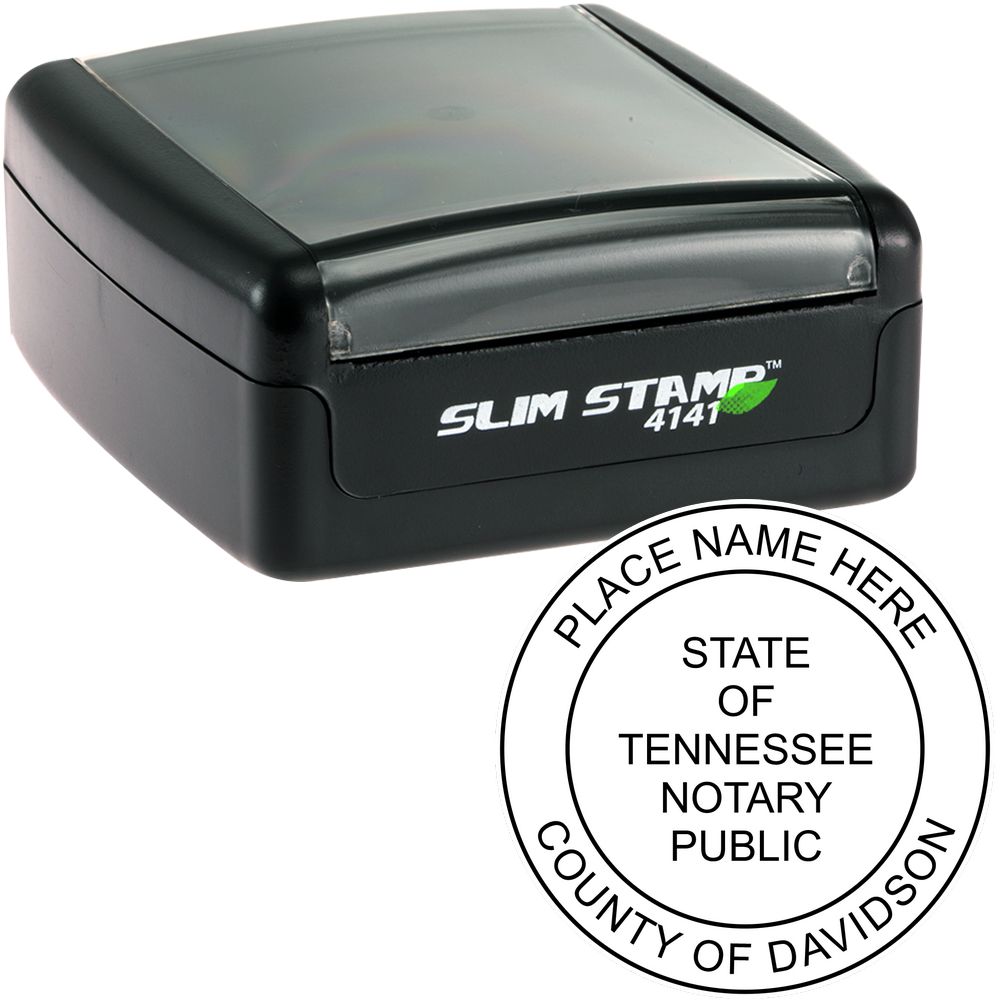
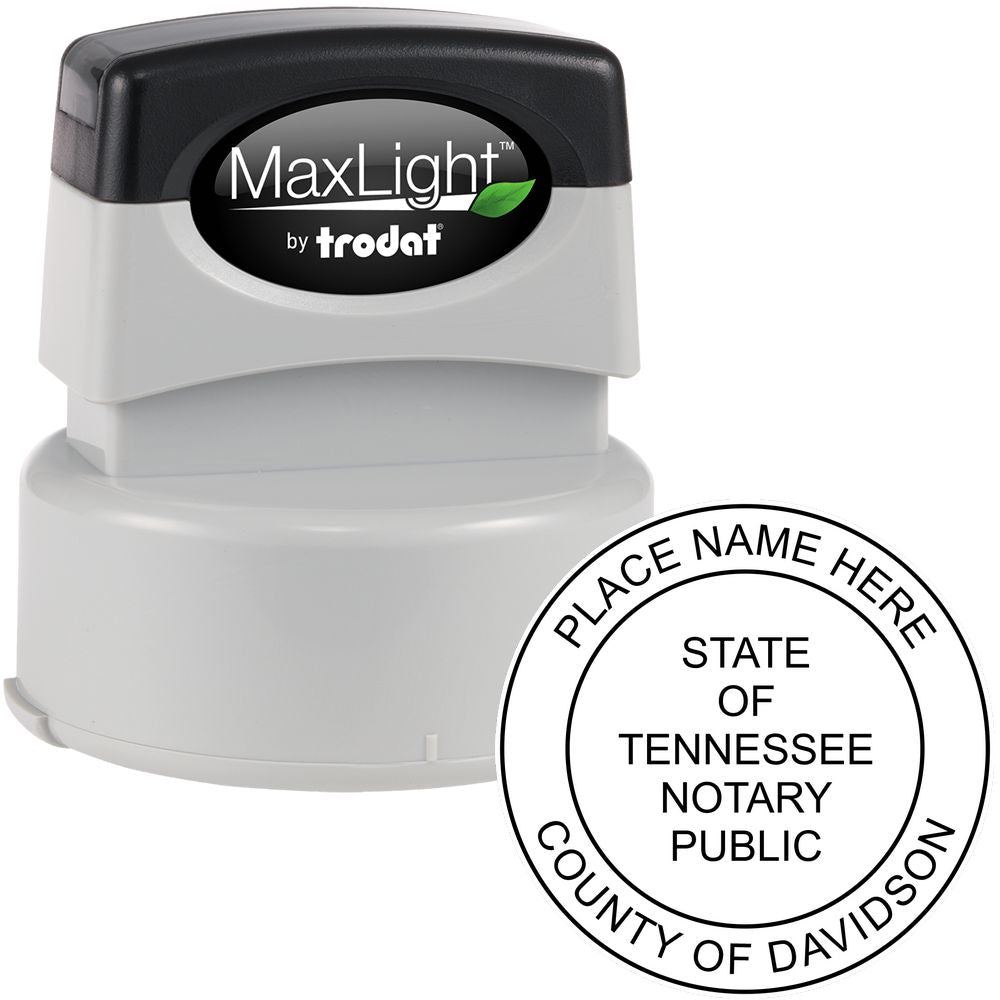
A Tennessee notary seal must be circular, and it may be inked in any legible color except black or yellow. Your commissioned name runs across the top, your county of election across the bottom, and a Tennessee Notary Public legend fills the center. The color you pick must still copy as black. This page covers the seal face, ink, embossers, county notices and ordering.
Engineer Seal Stamps compliance desk. Checked against Tenn. Comp. R. & Regs. 1360-07-02-.01 and the Tennessee Secretary of State. Sources read September 2026.
| Requirement | What the rule says | Source |
|---|---|---|
| Official seal | Required. The rule sets the seal's shape and its wording. | Tenn. Comp. R. & Regs. 1360-07-02-.01 |
| Outline | A circle. | Tenn. Comp. R. & Regs. 1360-07-02-.01 |
| Top of the circle | Your name, matching the way your commission prints it. | Tenn. Comp. R. & Regs. 1360-07-02-.01 |
| Bottom of the circle | The county whose legislative body elected you. | Tenn. Comp. R. & Regs. 1360-07-02-.01 |
| Center text | Either State of Tennessee Notary Public or the shorter Tennessee Notary Public. | Tenn. Comp. R. & Regs. 1360-07-02-.01 |
| Diameter | No size is given. Only the circular shape is fixed. | Not addressed in the cited rules |
| Ink | Any clearly legible color other than black or yellow, provided a non-color copier renders it black. Blue, purple, green or red can work. | Tennessee notary seal statute |
| Copy test | A document is judged by whether it legibly reproduces the seal's required elements. | Tennessee notary statute, § 8-16-114(b) |
| Embossed seal | Allowed, and an emboss used after May 12, 2003 cannot make an acknowledgment defective. A blind emboss alone will not pass the copy test. | Tennessee notary statute, § 8-16-114(b) |
| Missing paper seal | No reporting step or deadline is set for a lost or stolen paper seal. | Not addressed in the cited rules |
Moving your commission to another state? Compare its rule in notary seal requirements by state.
Which ink colors can a Tennessee notary seal use?
Any color except black or yellow, as long as the imprint is clearly legible and reads as black when copied on a non-color copier. Blue, purple, green and red all fit. Black and yellow are the two colors the seal statute rules out.
This reverses a common habit. Black ink is the usual default, and in Tennessee it is one of the two excluded colors. Choose the color when you order.
A pale shade that fades on a black and white copy fails too, even though it is neither black nor yellow. For background, see our overview of Tennessee notary stamp law.
What has to appear on the face of a Tennessee notary seal?
Three pieces of text inside a circle. Your name goes across the top exactly as the commission shows it, your county of election goes across the bottom, and the center carries either State of Tennessee Notary Public or Tennessee Notary Public.
- Top line: your name, spelled and formatted the way your commission prints it.
- Bottom line: the county whose legislative body elected you.
- Center: one of the two approved legends. The rule accepts either one.
- Outline: a circle. Square and rectangular layouts do not match the rule.
The county line reflects how Tennessee commissions its notaries. Your county's legislative body elects you, and the clerk of that county is where later name and county notices go. For a line-by-line reading of each element, see Tennessee notary seal requirements explained.






Is there a required size for a Tennessee notary seal?
No. The rule fixes the shape as a circle and gives no diameter, minimum or maximum. The practical limit comes from legibility, since every line inside the circle has to read clearly on the original and again on a copy.
A long name or county name needs enough room to stay readable, so give the full wording when you order and let the layout follow the text.
Can a Tennessee notary use an embosser?
Yes. An embossed seal used after May 12, 2003 does not make an acknowledgment defective, and older impression seals stayed valid until the end of their holder's term. The statute's working design still centers on an inked stamp, which matters for copies.
The statute pictures the seal as a rubber stamp or some other kind of stamp, and the color rule is attached to that stamp. Section 8-16-114(b) then judges a document by whether it legibly reproduces the seal's required elements. A raised impression with no ink has no color and shows little on a copy, so on its own it falls short of that measure.
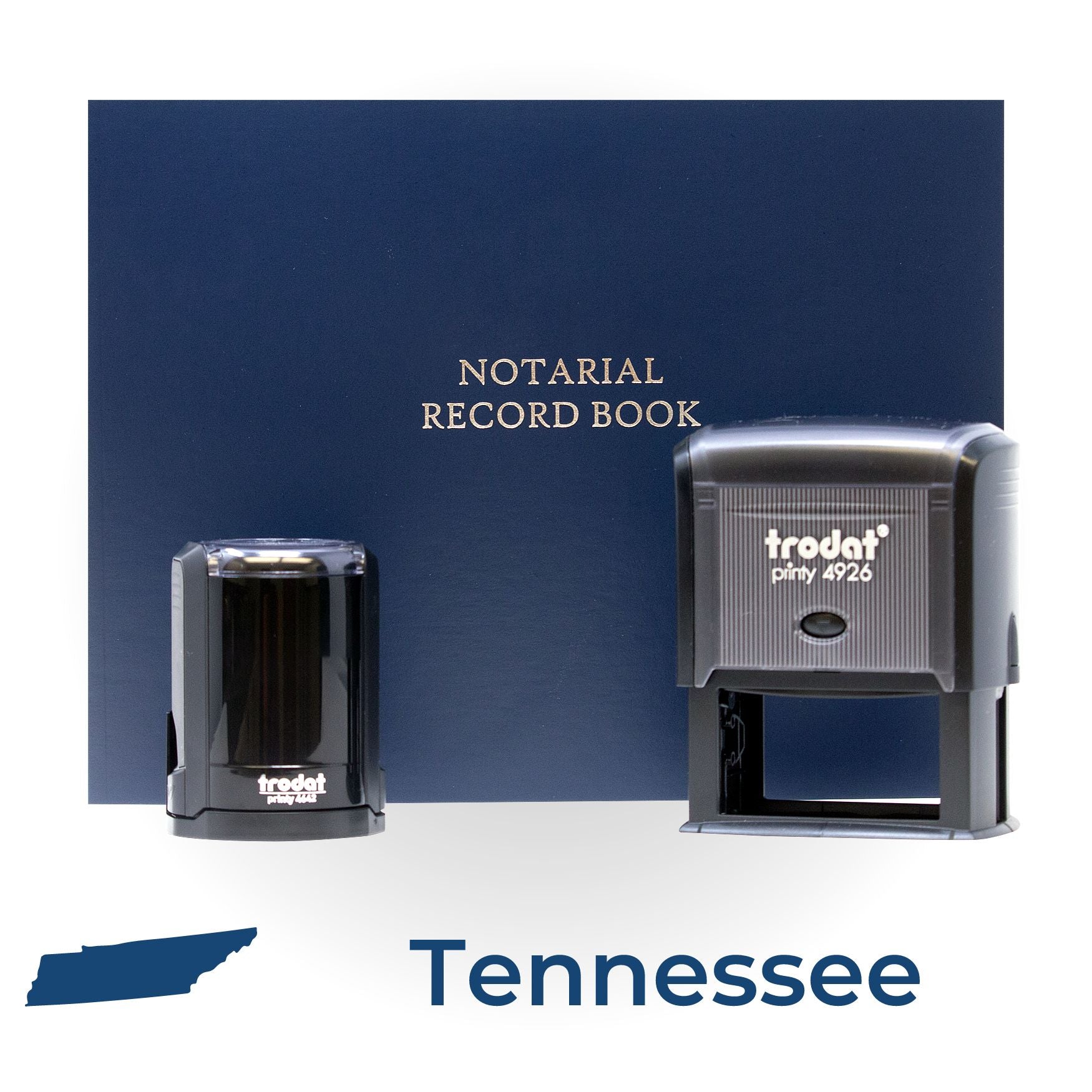
The workable approach is an inked stamp for every act, with an embosser as an optional extra. For a shorter version of these rules, see our plain-language summary of Tennessee stamp requirements.







Why does Tennessee ban black ink yet want the seal to copy as black?
The two conditions govern different things. The ban covers the ink on the original document, while the copy condition covers how that ink reproduces on a non-color copier. A clearly legible blue, purple, green or red can satisfy both at once.
Section 8-16-114(b) adds a third angle: legible reproduction of the seal's required elements. Together, the provisions favor a crisp impression in an allowed color, and a faint one falls short whatever its hue.
Who commissions a Tennessee notary, and when can the seal first be used?
Several offices share the process. Your county's legislative body elects you. The Governor then issues the commission, which the Secretary of State transmits and administers, and your $10,000 surety bond is held by the county clerk.
The bond comes before any notarial act. Performing a notarial act while the bond is still unfiled is a Class C misdemeanor, so treat the day the clerk has your bond on file as the first day the new seal can go on a document.
How long does a Tennessee notary commission run?
Four years, counted from the day the Governor issues your commission. An expiration date is not one of the required seal elements, so the end of your term is something you track yourself rather than something the rule puts on the seal.
The term also marks the limit for older impression seals, which the statute let notaries keep using until the end of their term of office. For timing questions, see when a Tennessee notary seal expires and our notes on renewing a Tennessee notary stamp.
Where do you report a name change or a move to another county?
File it with the clerk in your county of election. The Secretary of State is not the office that takes this notice. A new surname, or a move of home or principal place of business into a different Tennessee county, is reported to that clerk, and it costs $7.
From there the clerk passes the notice to the Secretary of State and sends along $2 of the fee. Because the top line of your seal carries your name as your commission shows it, a surname change is also the moment to compare your seal against the updated record.
What if a Tennessee notary seal is lost or stolen?
The cited rules do not address it. The material read for this page sets no reporting duty, no deadline and no notice procedure for a missing paper seal, so there is no Tennessee step to cite for this situation.
The silence does not relax the design rules. A new stamp follows the same circular layout, name, county and legend, in an allowed ink color.
What should you have ready when ordering a Tennessee notary stamp?
Your name exactly as the commission prints it, your county of election, your choice of center legend, and an ink color other than black or yellow. Those details cover every element the design rule lists, and the circular shape is set for you.
- Commission name: copied letter for letter.
- County of election: the county whose legislative body elected you.
- Center legend: State of Tennessee Notary Public or Tennessee Notary Public.
- Ink color: blue, purple, green or red are the workable choices.
- Embosser: optional, as a second device beside the inked stamp.
Our guide to buying a Tennessee notary stamp goes through the purchase itself.
How do you check a Tennessee seal impression before the first notarization?
Stamp a blank sheet, compare the name, county and legend against your commission, then run the sheet through a black and white copier. Every line should read on the copy, the seal should show as black there, and the original should be neither black nor yellow.






Frequently asked questions
Does a Tennessee notary seal need a commission number or an expiration date?
Neither is on the rule's list. The required elements are the circular form, your name, your county of election and the center legend.
Is the short legend Tennessee Notary Public as good as the longer one?
Yes. The rule names both State of Tennessee Notary Public and Tennessee Notary Public as acceptable center text.
Is a light green ink acceptable if it copies faintly?
No. Green is an allowed color only when the imprint is clearly legible and appears black on a non-color photocopy. A shade that copies faintly misses that condition.
Can I notarize as soon as the Governor issues my commission?
Not until your $10,000 surety bond is filed with the county clerk. Notarizing before then is a Class C misdemeanor.
Does the Secretary of State collect my name change fee?
No. The $7 fee is paid to the clerk of the county that elected you, and that clerk forwards $2 of it to the Secretary of State along with the notice.
Once your bond is on file, order your seal from our Tennessee stamps and seals collection with your commission name, county of election and ink color in hand.