
Why the Wrong PE Seal Type Can Cost You Your License
Most engineers assume any PE seal will do. That assumption is wrong, and it carries real disciplinary risk.
State licensing boards have issued warnings, fines, suspensions, and even license revocations for improper seal use. Using the wrong seal type is one of the most common triggers for a board investigation, and it is entirely avoidable.
Three legally distinct PE seal types exist: the rubber (wet ink) stamp, the embossing (impression) seal, and the digital e-stamp. Each carries different legal standing depending on the state where your documents are submitted. What is perfectly compliant in Florida may violate the rules in New Jersey.
This article breaks down the differences between these three seal types, maps out state-by-state requirements, identifies compliance traps that catch even experienced engineers, and provides a clear framework for choosing the right seal for your jurisdiction.
The Three PE Seal Types: What They Are and How They Work
Rubber / Wet Ink Stamp
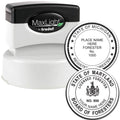
A rubber stamp (pre-inked or self-inking) applies a circular ink impression directly to paper. It is the fastest physical sealing option and is widely accepted across the majority of U.S. states. However, it is explicitly prohibited in some jurisdictions. New Jersey, for example, bans rubber stamps for paper documents entirely; PEs there must use an embosser that crimps the paper.
Embossing (Impression) Seal
An embossing seal crimps or presses a raised impression into the paper without ink. It is the most traditional PE seal format and remains universally recognized. Because the impression physically alters the document, embossed seals are difficult to reproduce, which is why certain states mandate them over rubber stamps.
Digital E-Stamp
A digital e-stamp is an electronic seal image applied to PDF or digital documents. This is where compliance gets nuanced, because two critical subtypes exist. An image-only seal (a JPEG, PNG, or scanned stamp placed on a document) is not the same as a true cryptographic digital seal. The distinction matters enormously.
Under the NCEES Model Rules (August 2025 edition), a compliant digital seal must be unique to the licensee, independently verifiable, under the sole control of the engineer, and linked to the document so that any data change invalidates the signature. A simple image file of your stamp does not satisfy these requirements. Most state boards evaluate digital seals against this standard, and using an image-only seal can result in document rejection or disciplinary action.
Regardless of seal type, a complete PE certification always requires three components: the seal image, a handwritten or approved electronic signature, and a date. The seal alone is never sufficient for legal certification.
State-by-State Breakdown: What Your Jurisdiction Actually Requires
All 50 U.S. states plus the District of Columbia, Guam, Puerto Rico, the U.S. Virgin Islands, and the Northern Mariana Islands regulate PE licensure and seal requirements. The rules vary significantly from one jurisdiction to the next.
States That Accept All Three Types
A large group of states explicitly permits impression (embossed), rubber stamp, and electronic seals. This group includes Colorado, Florida, Georgia, Idaho, Indiana, Iowa, Kansas, Kentucky, Maine, Maryland, Massachusetts, Missouri, Montana, Nebraska, New Hampshire, New Mexico, North Carolina, Ohio, Rhode Island, South Carolina, Tennessee, Utah, Vermont, West Virginia, Wisconsin, and Wyoming. Engineers in these states have the most flexibility in choosing a seal type.
Restrictive Outliers
New Jersey prohibits rubber stamps for paper documents. PEs in New Jersey must use an embosser-type seal that crimps the paper. New Jersey does accept digital seals for electronic submissions, but the paper-document restriction catches many engineers off guard, especially those relocating from states with broader acceptance.
Digital-Skeptic Outliers
Hawaii and Guam do not accept computer-generated dates and signatures on PE seals. These jurisdictions are notable exceptions to the broader trend toward digital acceptance and require engineers to use traditional physical sealing methods.
Format Outliers
Nearly every state requires a circular seal, but two states break from that standard. Minnesota requires a rectangular PE stamp measuring 2" x 1.5". Rhode Island requires a square stamp with 1-15/16" sides. Engineers licensed in these states need seals built to these specific dimensions.
Size Requirements
Even among circular seals, diameter specifications differ. California requires a minimum 1.5" diameter. Florida requires at least 1-7/8". Maryland specifies a range of 1-5/8" to 2". Kansas defines both an outer circle (1-5/8") and an inner circle (1-1/16") dimension. Missouri mandates exactly 1-3/4". Getting the size wrong can render your seal non-compliant.
Branch Designation Rules
Washington State permits rubber stamp seals but restricts branch designations. The only branch designation allowed on a Washington PE stamp or seal is "Structural Engineer." Civil, electrical, and mechanical branch labels are not permitted on the stamp.
Digital Seal Conditions
Oregon allows digital seals for final electronic documents, but only when the digital signature is unique to the registrant, independently verifiable by a Certificate Authority, under sole control of the registrant, and invalidated if any document data is changed. These conditions mirror the NCEES Model Rules framework closely.
The Agency vs. State Board Trap: Why State Compliance Isn't Always Enough
Here is a critical distinction most engineers miss: your state board may permit digital seals, but a specific filing office, county building department, city permitting office, or Authority Having Jurisdiction (AHJ) may still require a wet stamp or embosser on submitted documents.
Some agencies impose additional requirements beyond state board rules. For example, certain offices require notices such as "printouts are not signed" on digitally sealed documents. This adds a compliance layer that many engineers do not anticipate until a submission is rejected.
The solar energy permitting boom has made this issue more visible. AHJs across the country are updating their submittal requirements in real time, creating compliance challenges for engineers sealing solar plan sets. Traditional wet stamp packages can take 5 to 7 days to prepare and ship, while digital submissions typically arrive in 24 to 48 hours (up to 85% faster). The efficiency advantage of digital sealing is clear, but only if the receiving agency accepts it.
Practical advice: always verify current requirements with both your state licensing board and the specific receiving agency before sealing final documents.
Consider the multi-state PE scenario. An engineer licensed in New Jersey (embosser required for paper) who also seals documents in Florida (all three types accepted) must maintain two entirely different sealing workflows, one physical and one digital. Managing these parallel requirements is a growing reality for engineers practicing across state lines.
How to Choose the Right PE Seal and Stay Compliant
Follow these steps to ensure your PE seal meets every applicable requirement:
- Identify your state board's explicit seal type requirements. Determine whether rubber stamp, embossing seal, digital e-stamp, or all three are permitted in your licensing state.
- Verify the required seal layout elements. Most states require the licensee's legal name, license number, state name, "Professional Engineer" designation, and (where applicable) branch or discipline wording. These elements must be consistent across your physical and digital seal versions.
- Confirm size and shape requirements. Most states require a circular seal between 1.5" and 2" in diameter. Minnesota (rectangular) and Rhode Island (square) are the exceptions. Get this wrong and your seal is non-compliant from day one.
- If using a digital seal, confirm it meets cryptographic standards. A JPEG or PNG of your stamp is not a compliant digital seal. It must be PKI-based, tamper-evident, and independently verifiable, consistent with the NCEES Model Rules (August 2025 edition).
- Check agency-level requirements for every jurisdiction where you submit documents. State board compliance alone is not always sufficient. The specific building department, permitting office, or AHJ may have additional rules.
Many engineers now operate a hybrid workflow, maintaining both a physical seal for paper submissions and a digital seal for electronic submissions. This dual approach covers the full range of agency requirements. At EngineerSealStamps.com, we include a free digital seal with many professional seal purchases, giving engineers a compliant electronic version ready for PDF and digital plan submissions alongside their physical stamp.
One final note: the NCEES Model Rules are updated regularly (most recently in August 2025), but individual states adopt changes on their own timelines. There is often a lag between NCEES best-practice guidance and actual state law. Always verify current rules with your licensing board before sealing final documents.
Get the Right PE Seal for Your State, Without the Guesswork
PE seal requirements are state-specific, agency-specific, and seal-type-specific. There is no universal answer, and assumptions lead to compliance failures.
Using the wrong seal type is one of the most common and avoidable causes of board investigations. Sanctions can include warnings, fines, suspension, or license revocation. For a licensed professional engineer, the stakes are too high for guesswork.
At EngineerSealStamps.com, we build PE seals around the state-specific requirements that matter: proper layout, required wording, license information, and professional presentation tailored to each jurisdiction. The free digital seal included with many purchases addresses the hybrid workflow need directly, so engineers receive both a physical stamp and a compliant electronic version in one order.
Verify your state's current requirements, then order a seal built specifically for your jurisdiction's rules. Getting it right the first time protects your license, your reputation, and your work.