
To become a Texas notary public, you must be a Texas resident aged 18 or older with no felony or moral turpitude conviction, pass the Secretary of State's education course, buy a $10,000 surety bond, and apply through the SOS Notary Portal with the $21 fee. The course became mandatory for applications filed on or after January 1, 2026. A commission lasts four years. This guide covers each step, the bond, the seal and renewal.
Engineer Seal Stamps compliance desk. Checked against the Texas Secretary of State notary pages, Tex. Gov't Code chapter 406, Senate Bill 693 and 1 TAC chapter 87. Sources read September 2026.
| Step or rule | Texas answer | Authority |
|---|---|---|
| Eligibility | Texas resident, 18 or older, with no conviction for a felony or a crime involving moral turpitude | Tex. Gov't Code § 406.004 |
| Education | A Secretary of State course of no more than two hours, completed within one year before you apply | SB 693; 1 TAC §§ 87.8, 87.13 |
| Exam | No separate exam; you must answer at least 70% of the course questions correctly | 1 TAC § 87.8 |
| Course fee | $20 each time you take the course | 1 TAC § 87.5 |
| How to apply | Online through the SOS Notary Portal, with bond Form 2301-B uploaded | SOS application guide, revised 12/16/2025 |
| Application fee | $21: $10 to file the bond, $1 state fee and $10 for the commission | Tex. Gov't Code § 406.007 |
| Bond | $10,000 from a solvent surety company authorized to do business in Texas, payable to the governor | Tex. Gov't Code § 406.010(a) |
| Oath | Sworn before a notary or other official; you cannot give your own oath | Tex. Gov't Code § 406.010(c), (d) |
| Commission term | Four years from the date you qualify | Tex. Gov't Code § 406.002 |
| Seal | Required on every official act. See the Texas notary seal hub | Tex. Gov't Code § 406.013 |
| Record book | Required; keep entries for the commission term or three years, whichever is longer | Tex. Gov't Code § 406.014; 1 TAC § 87.54 |
| Renewal | Apply no sooner than 90 days before expiration, after the continuing education course | 1 TAC §§ 87.15, 87.9 |
| Online notary | Separate application with a digital certificate and electronic seal; the term ends with your traditional commission | Tex. Gov't Code § 406.105; SOS notary FAQs |
Two national tables put this Texas guide in context: which states require a notary journal and where remote online notarization is allowed.
Who qualifies to be a notary public in Texas?
Any Texas resident aged 18 or older qualifies, provided they have no final conviction for a felony or for a crime involving moral turpitude. The Secretary of State runs a background check on every applicant.
Residency is a firm requirement under Gov't Code § 406.004, so a Texas business address alone does not qualify you. State employees follow a separate path: when notary work is done mainly as a state officer or employee, the bond requirement does not apply, and the application steps list a SORM-203 acknowledgment form and an interagency voucher (ITV) to pay the fee.
What is the step-by-step process for a Texas notary commission?
Texas runs the process through the SOS Notary Portal. You open an account, finish the course, buy a bond, file the application and fee, then sign and notarize your commission before your first act.
- Create an SOS Notary Portal account.
- Pay the $20 course fee and finish the course and its assessment within 90 days.
- Buy a $10,000 bond and get the completed Form 2301-B from the surety, showing the bond number, company name, agency address and authorized signature.
- Start the application with your personal details, notary information and criminal history statements.
- Upload the bond form, review, sign with your name and a drawn signature, and pay by credit card.
- Download the commission certificate from your portal dashboard after approval. The download works only once, so save it securely.
- Take the oath and have the certificate notarized, then order your seal.
The Secretary of State's guide notes that this self-service route is not for applicants who have a company submit the application for them. The Secretary of State's notary public page links each current guide.
What does the Texas notary education requirement involve?
Senate Bill 693 requires education for every appointment or reappointment application submitted on or after January 1, 2026. The Secretary of State's course runs no longer than two hours, and you must answer at least 70% of its questions correctly.
Only the course the Secretary of State offers counts. The rules set the terms:
- Fee: $20, paid again for every attempt.
- Deadline: finish within 90 days after the Secretary of State receives the fee, or the fee is forfeited.
- Attempts: no more than 3 in any 3-month period.
- Timing: complete it within one year before you submit the application.
The traditional course is four videos followed by an assessment you complete within 30 minutes. There is no separate state exam; the course assessment fills that role. Renewing notaries take a continuing education course on the same terms.
How much does it cost to become a Texas notary?
The state's charges are $20 for the course and $21 for the application. The bond premium is set by the surety company you choose, and the seal and record book are separate purchases.
The $21 application fee is fixed by Gov't Code § 406.007: $10 for approving and filing the bond, $1 for Secretary of State investigation and materials, and $10 for the commission itself. Retaking the course means another $20. A later name change costs a $20 filing fee. The Secretary of State cannot recommend bond companies, so compare sureties yourself.
How does the $10,000 Texas notary bond work?
Before taking office you must execute a $10,000 bond with a solvent surety company authorized to do business in Texas. It is payable to the governor and pays people harmed by your notarial acts; it does not protect you.
The bond is filed with the Secretary of State and is not void on first recovery: an injured party can sue on it again and again until the full $10,000 is paid out. The Secretary of State's FAQ draws the line clearly: an errors and omissions policy is extra insurance that protects the notary, not the public, and it does not replace the bond.
Each application, including a renewal, needs its own bond form. Online notaries do not need a second bond beyond the one tied to the traditional commission.
Which seal does a Texas notary need after the commission is issued?
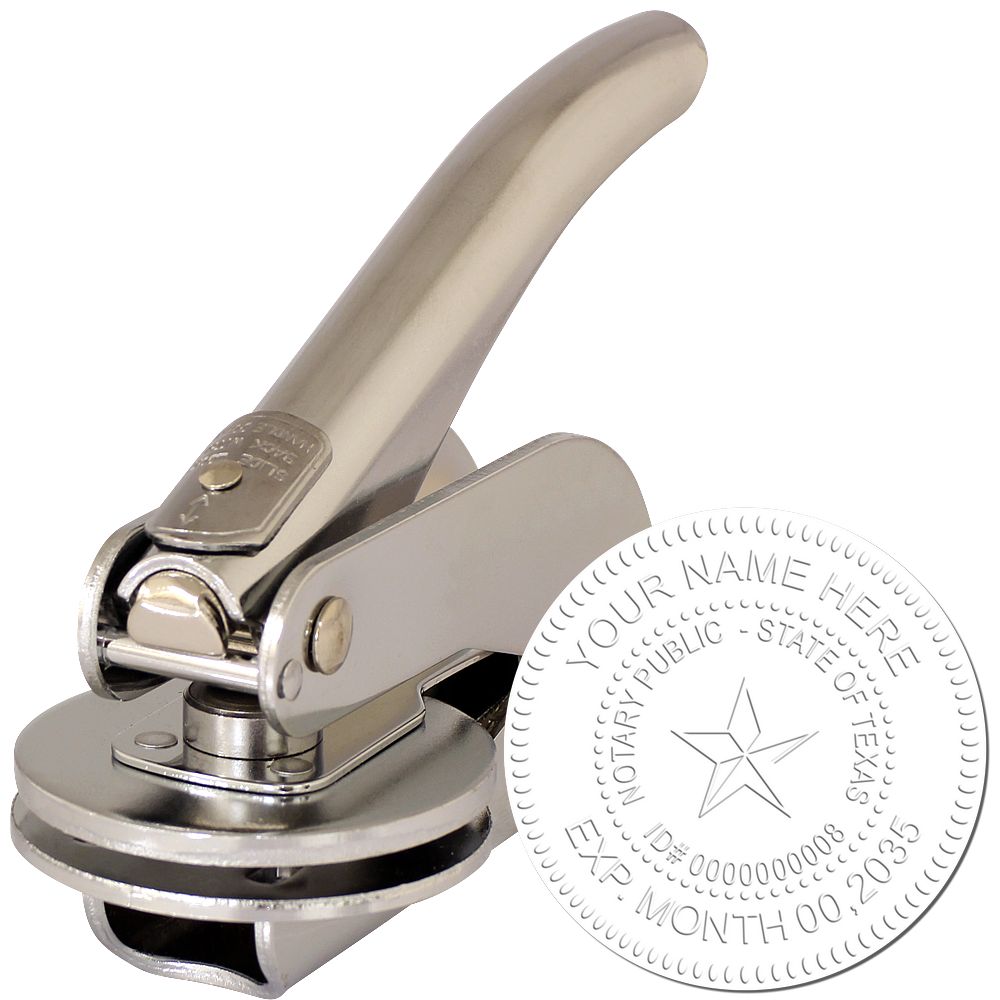
Every official act needs your seal, and you can order it only once you are commissioned, because it carries the identifying number the Secretary of State assigns and your commission's expiration date.
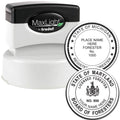
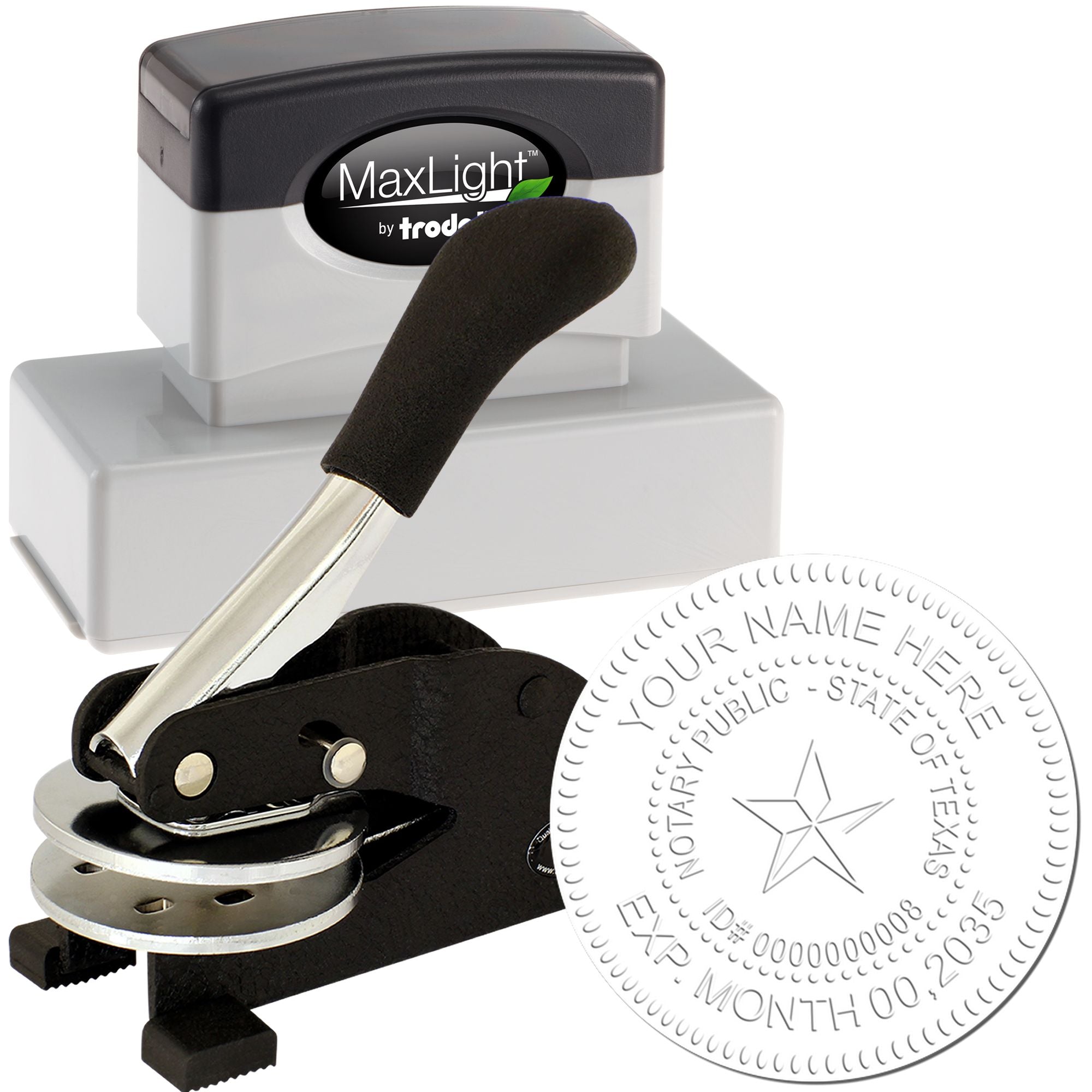
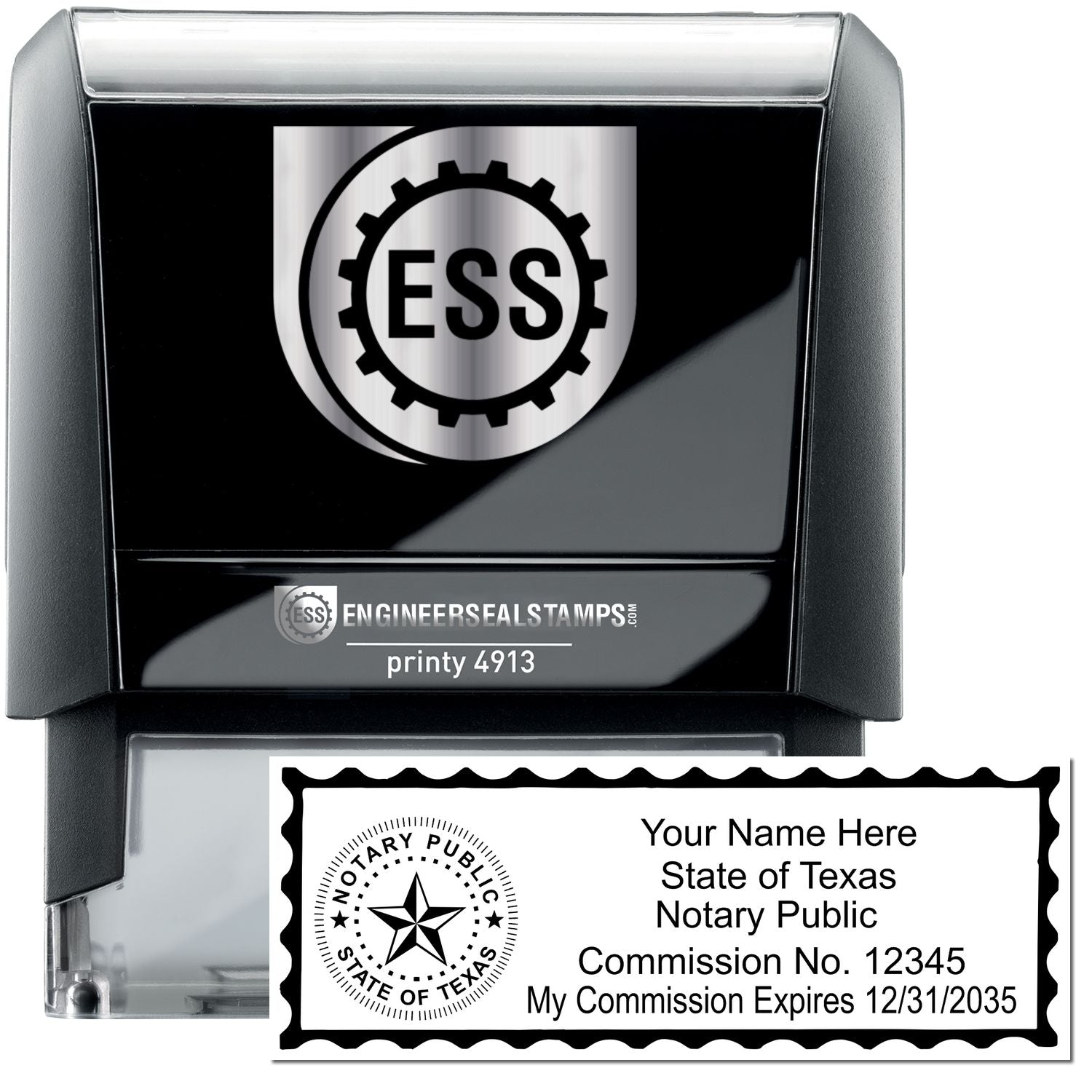
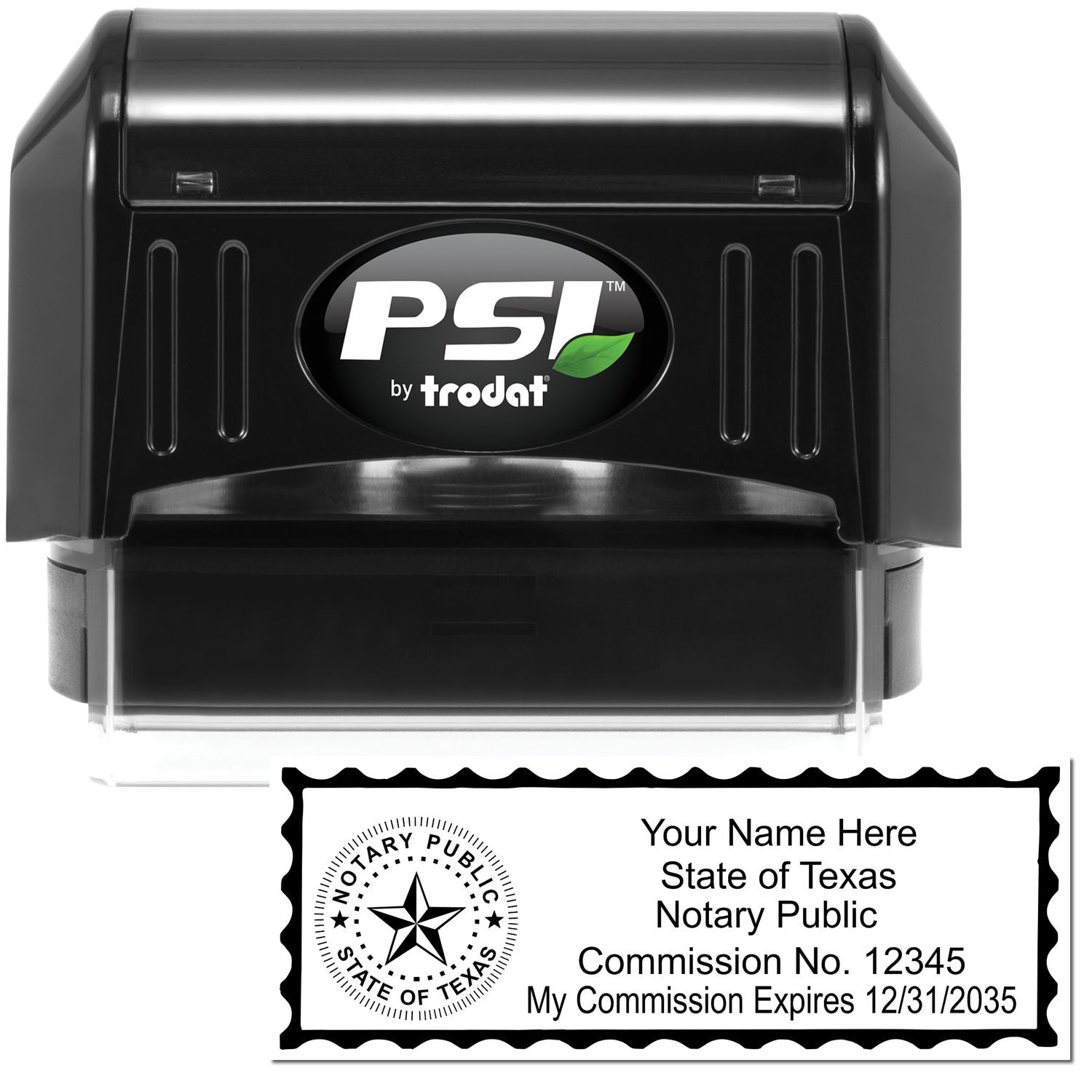
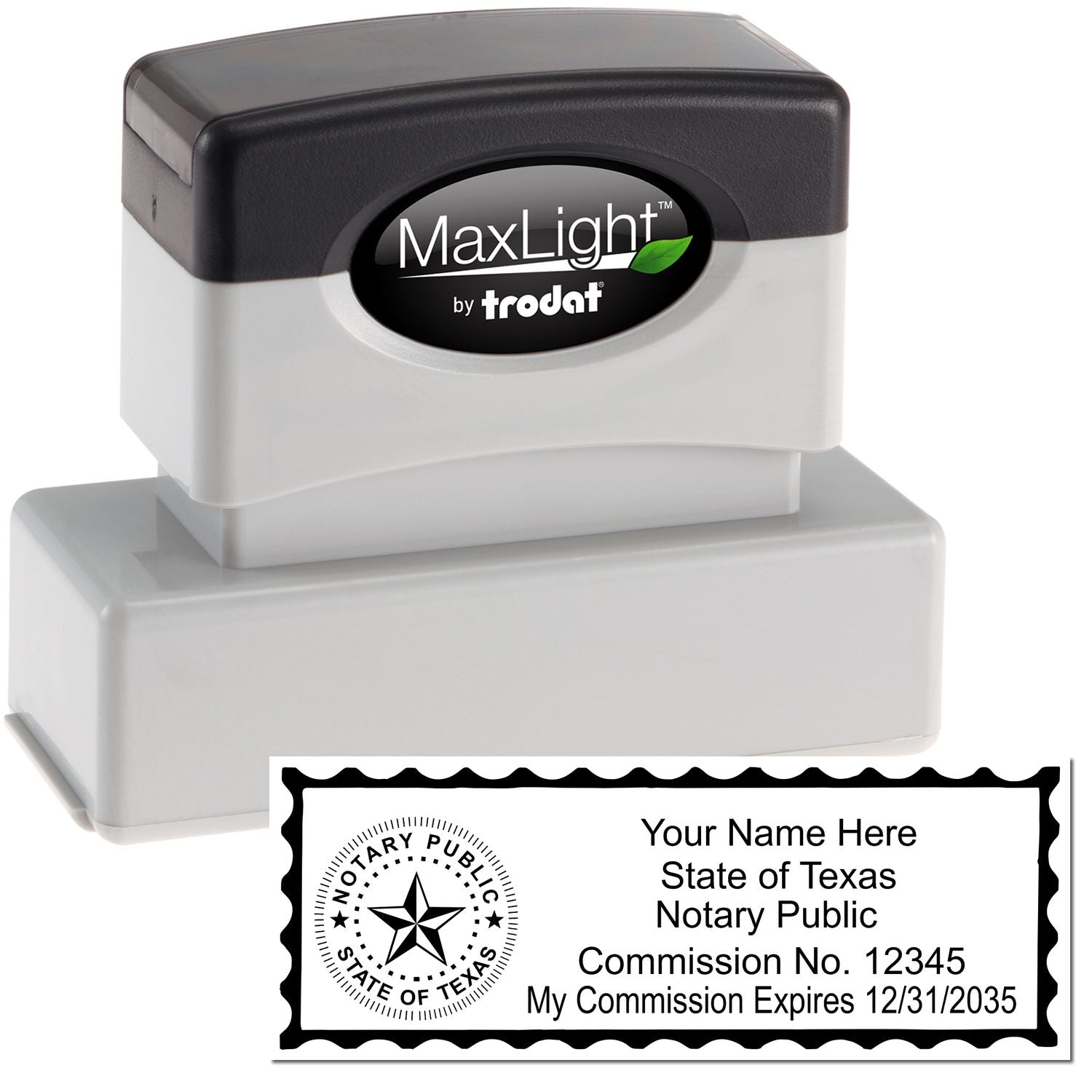
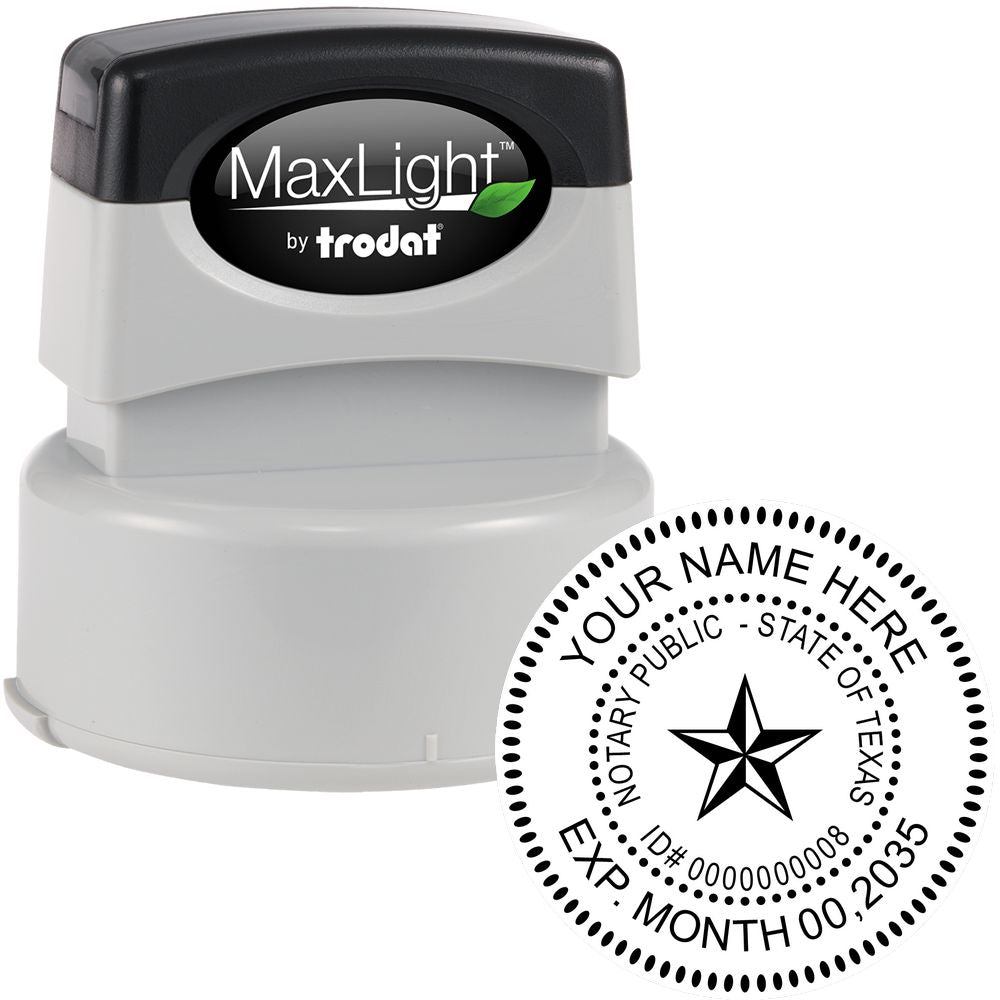
The die shows a star of five points ringed by the words "Notary Public, State of Texas," your name as commissioned, your notary ID number and your expiration date, inside a serrated or milled edge. The name must match the name on your application. A round die may be up to 2 inches across; a rectangular die up to 1 by 2.5 inches.
The impression must reproduce every element legibly when photocopied, so a blind embosser cannot be your only seal. The Secretary of State's training FAQ says you may buy the seal and record book from any office supply company once commissioned. Our Texas notary seal hub covers each element and what to do if a seal is lost or stolen.





What goes in a Texas notary record book?
Texas requires a record of every notarization, on paper or electronically. Keep each entry for the term of the commission in which you made it or three years after the notarization, whichever is longer.
- The date of the document and the date of the notarization
- The name and address of each signer and any witness
- How each person was identified
- A brief description of the document
- For a property transfer, the original grantee's name and mailing address and the county involved
If you do not renew, the Secretary of State says to destroy the seal and turn the record book in to your county clerk. Online notarization records follow a longer rule of five years. A lost seal or book is reported through the SOS Notary Portal, with a police report attached if it was stolen, and you replace the seal before notarizing again.






How long is a Texas commission, and when can you renew?
A Texas commission expires four years after the date you qualify. The Secretary of State accepts renewal applications no sooner than 90 days before expiration, and each renewal now calls for the continuing education course.
A renewal is a full filing: the continuing education course, a new bond form and the $21 fee through the portal. Your new commission carries a new expiration date, so the old seal no longer matches it. Our guide to reading the expiration date on a notary seal shows what to check before you reorder.
How do you change your name or address on a Texas commission?
Report an address change to the Secretary of State in writing within 10 days. A name change during the term is optional and takes a surety rider, your current commission certificate and a $20 filing fee.
The Secretary of State calls the name change highly suggested but not mandatory, and it is filed through the SOS Notary Portal. Because the name on your seal must match the name under which you are commissioned, an amended name means a new seal.
Can you become an online notary in Texas?
Yes, once you meet the qualifications for a traditional commission. You file a separate online notary application with a digital certificate and an electronic seal, and the online term ends on the same date as your traditional commission.
The education requirement applies to the online application too. Your electronic seal must reproduce the required elements of the notary seal, and online notarization records are kept for five years.






Frequently asked questions
Is a Texas notary commission a certification?
No. Texas appoints and commissions notaries. The course assessment is a requirement for the application, not a separate certificate, and the state issues a commission certificate once you are approved.
How much is a Texas notary bond?
The bond amount is $10,000 by statute. The premium you pay is set by the surety company, and the Secretary of State does not recommend providers.
Can a Texas notary notarize in any county?
Yes. A Texas notary has statewide jurisdiction and may perform notarial acts in any county.
Do I need a round Texas notary seal?
No. Texas allows a round die up to 2 inches across or a rectangular die up to 1 by 2.5 inches. Both must show the same elements and reproduce legibly.
When can I start notarizing after approval?
After you download the commission certificate, take the oath and have the certificate notarized. Order your seal at that point, since it needs your ID number and expiration date.
Can a Texas state employee become a notary without a bond?
Yes, when the notary services are performed mainly as a state officer or employee. The application uses a SORM-203 acknowledgment form and an interagency voucher for payment.
Once your commission certificate is signed and your ID number is known, choose a round or rectangular seal, or an embosser to pair with it, from the ESS Texas stamps and seals collection. For a state-by-state view of seal rules, see our notary seal requirements across the states page.