A notary journal or register is mandatory for traditional notarizations in 28 of the 54 U.S. jurisdictions, and 11 more require one only for remote, online or electronic acts. Twelve leave it optional, and 11 of those recommend keeping one anyway. Georgia requires a journal only for self-filer acts, while South Dakota and Vermont set recording rules for remote acts instead. This page gives each jurisdiction's rule with its source, then covers format, retention, thumbprints and what to buy.
Engineer Seal Stamps compliance desk. Checked against each commissioning office and statute. Sources read September 2026.
| Jurisdiction | Journal rule | Source |
|---|---|---|
| Alabama | Not required. The state training course calls a journal highly recommended. | Alabama Notary Public Training Course |
| Alaska | Required for acts with remotely located individuals, with at least one journal kept on paper; keep it 10 years. | AS 44.50.078; Lieutenant Governor FAQ |
| Arizona | A paper journal is required for acts on tangible records. From September 12, 2026, the entry takes a right thumbprint for real property documents and powers of attorney. | A.R.S. § 41-319; SB 1479 (2026) |
| Arkansas | No legal requirement; the Secretary of State highly recommends one. | Secretary of State FAQ |
| California | Keep one active sequential journal at a time, and keep it locked. Take a right thumbprint for real property and power of attorney documents. | Gov. Code § 8206 |
| Colorado | Required for every act. Keep it 10 years after the last entry, send it to the State Archives, or leave it with an employer. | C.R.S. § 24-21-519; Secretary of State journals FAQ |
| Connecticut | No state law requirement; the Secretary of the State strongly recommends one. | Notary Public Manual |
| Delaware | Required of every notary, on paper or in electronic form; keep it 10 years after the last entry. | 29 Del. C. § 4332 |
| District of Columbia | Required: a permanent bound register with numbered pages, or an electronic journal that is tamper-evident. | D.C. Code § 1-1231.18 |
| Florida | Optional for paper acts. Online notaries keep an electronic journal for 10 years. | Governor's Reference Manual; Fla. Stat. § 117.245 |
| Georgia | Required since January 1, 2025, but only for acts performed for a self-filer. | O.C.G.A. § 45-17-8(g) |
| Guam | A chronological, permanently bound journal with numbered pages, signed by each person served. | 5 GCA §§ 33401 to 33403 |
| Hawaii | A soft-cover bound book with numbered pages, kept 10 years after its last act. | Haw. Admin. R. § 5-11-9 |
| Idaho | Not required; strongly recommended. | Secretary of State notary information page |
| Illinois | Every notary records each act, on paper or electronically. | 5 ILCS 312/3-107; 14 Ill. Adm. Code 176.900 |
| Indiana | Not required for paper notarizations. Remote notaries keep an electronic journal. | Indiana Notary Public Guide |
| Iowa | Not required; strongly recommended, with entries kept ten years. | Secretary of State notary handbook |
| Kansas | Required for every act since January 1, 2022; keep it 10 years. | K.S.A. 53-5a20 |
| Kentucky | Required for online notarizations; keep it ten years. | KRS 423.380 |
| Louisiana | The sections cited set record duties only for remote online acts, kept ten years. | La. R.S. 35:629 |
| Maine | Required for electronic and remote notarizations only; keep it 10 years after the last act recorded. | Secretary of State FAQ; 4 M.R.S. § 1920 |
| Maryland | Required: a bound paper register or a tamper-evident electronic file, kept 10 years after its last act. | Md. Code, State Gov't § 18-219 |
| Massachusetts | A chronological journal is required unless an exemption applies; keep it 7 years after the commission ends. | M.G.L. c. 222 §§ 22, 24 |
| Michigan | Not required for traditional acts. Required for remote acts and kept at least 10 years. | Notary FAQ; notary services page |
| Minnesota | Not required by law; the Secretary of State recommends one. | Secretary of State, Notary FAQ |
| Mississippi | Required for every act, paper or electronic. | Miss. Code Ann. § 25-34-37 |
| Missouri | One permanently bound book with numbered pages, kept 10 years from the last entry. | RSMo § 486.700 |
| Montana | Required for every notarial act; keep it 10 years. | Mont. Code Ann. § 1-5-618 |
| Nebraska | Not required of a general notary; the Secretary of State highly recommends one. | Secretary of State Notary FAQs |
| Nevada | Required for each act and entered when the act is performed; keep it 7 years after you stop being a notary. | NRS 240.120 |
| New Hampshire | Required for remote acts; keep it 10 years. | RSA 456-B:8-c |
| New Jersey | Required for every notarial act, one journal at a time; keep it 10 years. | N.J.S.A. 52:7-10.18 |
| New Mexico | Every act is recorded, on paper or electronically; keep it ten years after the last entry. | NMSA 1978 § 14-14A-18 |
| New York | Required of every notary since January 25, 2023; keep it at least 10 years. | 19 NYCRR § 182.9; DOS notary FAQs |
| North Carolina | Optional for traditional notaries. | G.S. 10B-38 |
| North Dakota | Required only for acts with remotely located individuals; keep it ten years. | N.D. Cent. Code § 44-06.1-16.1 |
| Ohio | Online notarizations need an electronic journal. | Ohio Rev. Code § 147.65 |
| Oklahoma | Recommended, not required, for paper acts. Remote online acts need an electronic journal kept ten years. | Secretary of State Notary FAQ; 49 O.S. § 206 |
| Oregon | Required for every act, paper or electronic; keep it at least ten years after the last entry. | ORS 194.300(1) |
| Pennsylvania | Required for every notarial act, on paper with numbered pages or in a tamper-evident electronic format. | 57 Pa.C.S. § 319 |
| Puerto Rico | Each testimonio gets a sequential number and is entered in a registry kept as the Notarial Regulation sets out. A monthly index of notarial activity goes to the Office of Notarial Inspection by the tenth day of the next month. | Ley 75 de 1987, Arts. 12, 58, 59; Oficina de Inspección de Notarías |
| Rhode Island | No legal requirement; strongly encouraged. | Department of State, Notary Public FAQs |
| South Carolina | Not required, though the Secretary strongly encourages one. | Secretary of State, FAQs about Notaries Public |
| South Dakota | The notary chapter sets no journal rule. Recordings of remote acts are kept ten years. | SDCL ch. 18-1; SDCL 18-1-11.2 |
| Tennessee | Record each act in a well-bound book; electronic records can qualify. | T.C.A. § 8-21-1201; Tenn. Att'y Gen. Op. 14-89 |
| Texas | A record book is required; keep entries for the commission term or three years, whichever is longer. | Tex. Gov't Code § 406.014; 1 TAC § 87.54 |
| U.S. Virgin Islands | Required unless you are a Virgin Islands attorney; keep it ten years, then deposit it with the Lieutenant Governor. | 3 V.I.C. § 829 |
| Utah | A physical journal for every commission issued on or after May 6, 2026; keep it 10 years after the last entry. | Utah Code § 46-1-13 |
| Vermont | No journal rule for ordinary acts. Remote acts require an audio-visual recording. | 26 V.S.A. § 5379 |
| Virginia | Required for paper notarizations performed on or after July 1, 2026; keep it at least five years. | Va. Code § 47.1-14 |
| Washington | A permanent bound book with numbered pages, kept ten years after the last entry. | RCW 42.45.180 |
| West Virginia | Not required, though the handbook strongly advises one. | West Virginia Notary Handbook |
| Wisconsin | Not required, but encouraged. | DFI Notary Public Handbook |
| Wyoming | Every act recorded, on paper or electronically, and kept under your sole control. | W.S. 32-3-118 |
Which states require a journal for every notarial act?
Twenty-eight jurisdictions require a journal or register for ordinary paper acts. Most apply the rule to every act, but Virginia's duty began July 1, 2026, Utah's covers commissions issued on or after May 6, 2026, and Massachusetts allows listed exemptions.
The full group: Arizona, California, Colorado, Delaware, the District of Columbia, Guam, Hawaii, Illinois, Kansas, Maryland, Massachusetts, Mississippi, Missouri, Montana, Nevada, New Jersey, New Mexico, New York, Oregon, Pennsylvania, Puerto Rico, Tennessee, Texas, the U.S. Virgin Islands, Utah, Virginia, Washington and Wyoming. The record book label used in Tennessee and Texas, and the numbered registry in Puerto Rico, count here because each one is a required record of notarial acts.
Several of these rules cover paper and electronic acts alike. Mississippi and Oregon apply the journal to every act in either medium, and Delaware, Illinois, Mississippi, New Mexico, Pennsylvania and Wyoming let the journal itself be kept on paper or electronically. Nevada adds a timing rule: the entry is made when the act is performed.





Which states require a journal only for remote, online or electronic acts?
Eleven jurisdictions do: Alaska, Florida, Indiana, Kentucky, Louisiana, Maine, Michigan, New Hampshire, North Dakota, Ohio and Oklahoma. A notary who works only on paper has no journal duty in these rows, but a remote or online authorization brings one, and nine of the eleven name a ten-year retention period.
The paper side still varies. Florida calls a journal optional for paper acts, Oklahoma recommends one, and Indiana and Michigan do not require one for traditional work. Maine's Secretary of State puts it plainly: a notarial officer must keep a journal for all electronic and remote notarizations and hold it for 10 years after the last act recorded.
Remote platforms often build the entry for you. Arkansas's handbook notes that some solution providers create a journal entry automatically as the certificate is completed, and Rhode Island's remote notary page says the act is recorded in the notary's digital journal. The state rules for remote acts, including recordings, are on our remote online notarization guide by state.
Which states only recommend a journal?
Twelve jurisdictions make the journal voluntary for traditional acts. In eleven of them the commissioning office or its training material recommends or encourages one; North Carolina's statute simply calls the journal optional for traditional notaries.
The group: Alabama, Arkansas, Connecticut, Idaho, Iowa, Minnesota, Nebraska, North Carolina, Rhode Island, South Carolina, West Virginia and Wisconsin. The strength of the advice differs. Connecticut, Idaho, Iowa, Rhode Island and South Carolina use "strongly" in their guidance, West Virginia's handbook strongly advises one, and Iowa's handbook suggests keeping entries for ten years even though no statute demands it.
Three jurisdictions sit outside these groups. Georgia requires a journal only for acts performed for a self-filer, a duty that began January 1, 2025. South Dakota and Vermont set no journal rule for ordinary acts; their rows name a recording rule for remote acts instead.
Does the journal have to be a bound book with numbered pages?
Only where the rule names that format. Eight rows in the table describe a bound book or numbered pages, while other rules accept an electronic journal that is tamper-evident. A few now insist on paper for paper acts.
Bound and numbered: the District of Columbia calls for a permanent bound register with numbered pages, Guam for a permanently bound journal with numbered pages, Hawaii for a soft-cover bound book with numbered pages, Missouri for a permanently bound book with numbered pages, and Washington for a permanent bound book with numbered pages. Mississippi's statute describes a permanent bound register with numbered pages for notaries who keep a paper journal, and Tennessee asks for a well-bound book.
Electronic allowed: the District of Columbia, Maryland and Pennsylvania accept an electronic journal if it is tamper-evident. Mississippi's rules spell out what that means in practice: the system must stop entries from being inserted, removed or swapped, stay recoverable after a malfunction, and produce entries in PDF on request.
Paper required: Arizona requires a paper journal for acts on tangible records, Utah requires a physical journal for commissions issued on or after May 6, 2026, and Virginia's new rule applies to paper notarizations. Alaska, which requires a journal only for remote acts, still wants at least one journal kept on paper.


How long must a notary keep the journal?
Ten years is the period named most often: 24 journal rows use it, usually counted from the last entry. Massachusetts and Nevada use seven years after service ends, Virginia uses five years, and Texas uses the commission term or three years, whichever is longer.
The start date matters as much as the number. Colorado, Delaware, Missouri, New Mexico, Oregon, Utah and Washington count from the last entry, Hawaii, Maine and Maryland from the last act recorded, Massachusetts from the end of the commission, and Nevada from the day you stop being a notary. A journal filled early in a long career can therefore stay in your custody well past the date of its final page.
Remote journals follow the same pattern. Kentucky's regulation requires the electronic journal to be kept ten years after the last act chronicled in it, and Florida, Louisiana, Michigan, New Hampshire, North Dakota and Oklahoma also set ten years for remote or online records.
What happens to the journal when the commission ends?
The rules name three outcomes: you keep it for the retention period, you deposit it with a public office, or it passes to someone the law names. Colorado and the U.S. Virgin Islands give the most specific instructions in our rows.
In Colorado, you keep the journal 10 years after the last entry, send it to the State Archives, or leave it with an employer. In the U.S. Virgin Islands, the journal is kept ten years and then deposited with the Lieutenant Governor. Mississippi's statute has a notary who resigns or whose commission is revoked deposit the journal records with the circuit clerk of the county of residence.
Massachusetts and Nevada tie retention to the end of service, seven years in each case, so an expired commission does not end the duty. If your commission date is close, check the timing on our guide to notary seal expiration dates before you order a new stamp.
Which states require a thumbprint in the journal?
Two jurisdictions in our table do: California, for real property and power of attorney documents, and Arizona, for real property documents and powers of attorney starting September 12, 2026. Both ask for the signer's right thumbprint.
No other journal row in the table names a thumbprint. If your journal will hold California or Arizona entries, choose one with space for a thumbprint in each entry.
What does a journal entry usually record?
Mississippi's statute gives a clear model: date and time, the record and type of act, each signer's full name and address, how identity was proved, where the act took place if not at the business address, and any fee.
Mississippi also wants the entry made at the time of the act, and other sourced rules add fields. The U.S. Virgin Islands notary FAQ lists the signer's signature and an identification number such as a driver's license number. Guam requires each person served to sign the journal. South Carolina's electronic notary law adds a description of the electronic system used, and Colorado asks remote notaries to record the provider that ran the session.
Check your own statute before you print a custom form, because the fields differ. Where a state lists no fields, the Mississippi set is a sound working template, though it carries no legal force outside Mississippi.
How does Puerto Rico keep notarial records?
Puerto Rico's Notarial Law uses a numbered registry rather than a journal statute. Each testimonio carries a sequential number tied to its registry entry, the registry follows the Notarial Regulation, and a monthly index of notarial activity goes to the Office of Notarial Inspection.
The index is due by the tenth day of the month after the month reported, and a notary with no activity files a negative report. The Office of Notarial Inspection says monthly reports and annual statistical reports are filed through the Sistema Integrado Notarial (SIGNO). Its inspectors review the Libro de Registro de Testimonios as part of their examination.
Which notary journal should you buy?
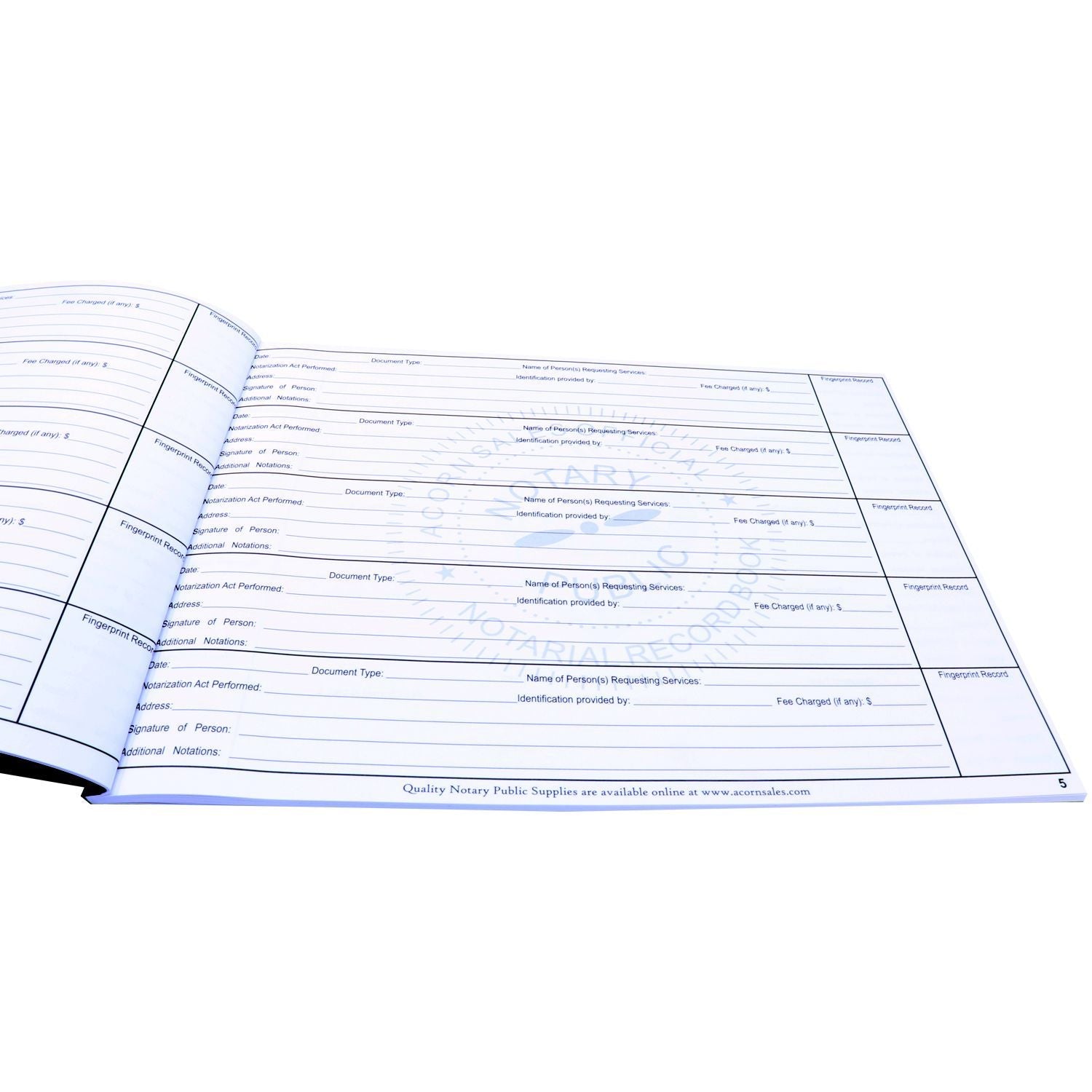
Buy the format your rule names. Where a bound paper journal fits, the ESS Official Notary Public Record Book is a dark blue soft-bound book, 8-1/2 by 11 inches, with over 50 pages and room for more than 250 entries.
Match the book to the fine print. If your rule asks for numbered pages or a permanently bound book, confirm the book you choose meets it. If you need thumbprints, choose a book with a print space in each entry. If your state accepts electronic journals, you still need a paper book for any act your rule says must be logged on paper.
For remote work, the journal usually comes from your platform. Arizona's Secretary of State notes that the RON platform creates the electronic journal entry. State-specific journal detail is in our Oregon notary journal guide and Illinois notary supplies guide, and the stamp side is in our state-by-state notary stamp requirements.






Frequently asked questions
Can I keep more than one journal at a time?
Not in California or New Jersey, which each allow one active journal at a time. Alaska goes the other way for remote work and wants at least one of your journals kept on paper. Elsewhere the rows are silent on the number of journals.
Should I keep a journal if my state does not require one?
Most of those offices say yes. Eleven of the twelve optional jurisdictions recommend or encourage one in official guidance, and a journal gives you your own dated account of who appeared and what was signed if an act is questioned later.
Can my employer keep my journal?
Only where the rule allows it. Colorado lets a departing notary leave the journal with an employer. South Carolina says an electronic notary's journal may not be surrendered to an employer when the job ends, and Wyoming requires the journal to stay under your sole control.
Does a remote notarization need a recording as well as a journal entry?
Often, yes. New Hampshire requires both and keeps each for ten years, while South Dakota and Vermont rely on a recording of the remote act. The recording rules for each state are in our remote online notarization table.
Is Georgia's journal rule for every notary?
No. Since January 1, 2025, Georgia requires a journal entry for each act performed for a self-filer, as O.C.G.A. § 44-2-2 defines that term. Other Georgia acts carry no journal duty in the cited rule.
How many entries fit in the ESS record book?
The product page lists room for more than 250 entries across over 50 pages. A busy notary may fill more than one book in a commission; keep every filled book for the full period your rule sets.
Order your record book, stamp and other notary supplies together from the ESS notary supplies collection.